Volt 1000N 3-Phasen Spannungsmessgerät für Energieverteilungssysteme
- Technology
- Modular power meters
- Partner
- Acal BFi
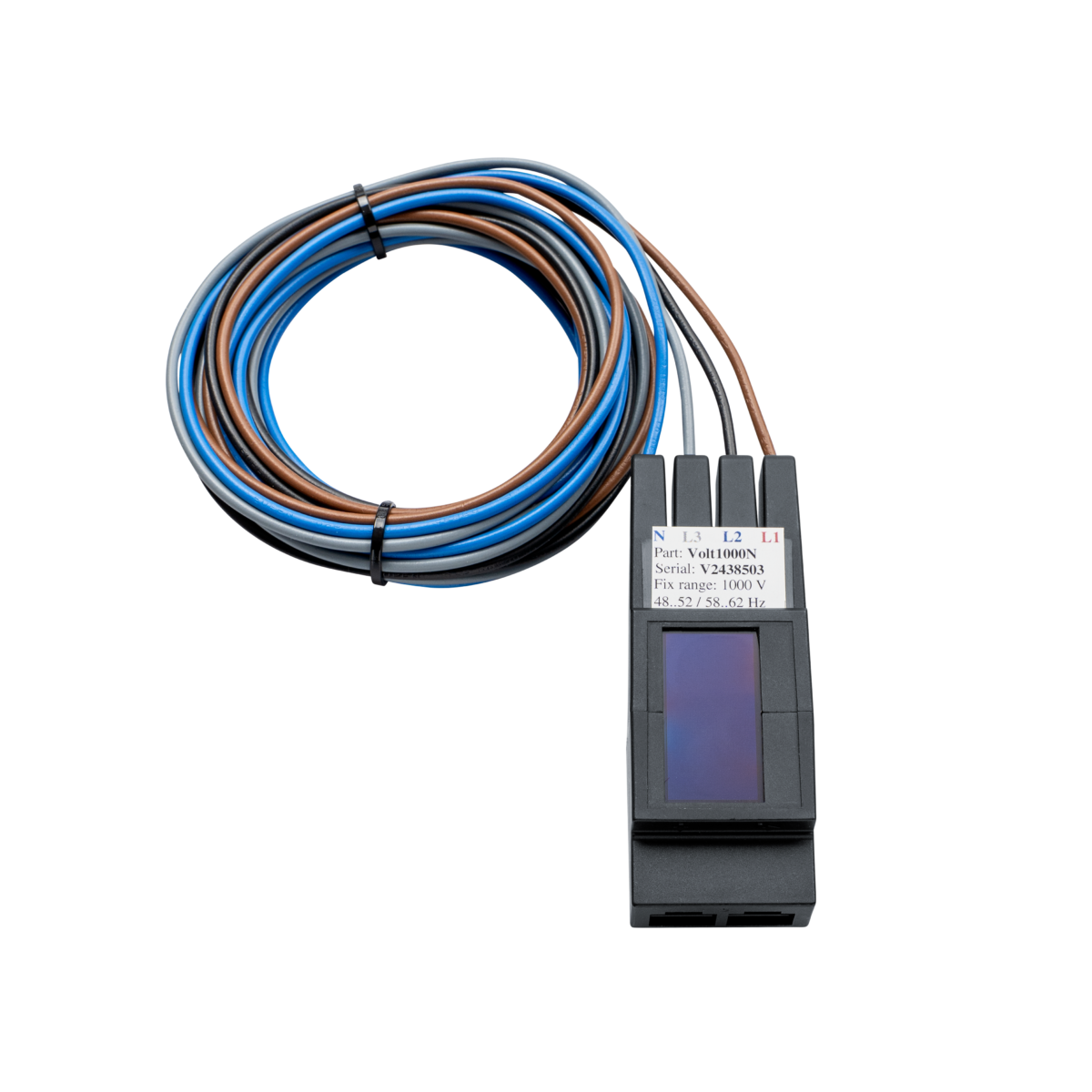
The Volt 1000N is a 3-phase voltage measuring device designed for use in electrical distribution networks and transformer stations. Mounted on a DIN rail, this compact module continuously monitors line voltages on L1, L2, L3 and neutral, giving utilities and industrial operators full visibility into their low-voltage grid status.
It features an integrated touch-panel display for local readings, allowing engineers to check phase voltages and system status at a glance on-site. The device communicates via RS-485 Modbus RTU, making it easy to integrate into SCADA systems or energy management setups for remote monitoring and control. Built-in threshold monitoring means the Volt 1000N can automatically trigger alerts (via indicator LEDs or a digital output) whenever voltages or phase conditions stray beyond set limits.
Typical applications include retrofitting existing substations to add real-time voltage oversight, monitoring power quality in networks with high renewable or EV charging loads, and ensuring compliance with grid regulations on voltage stability.
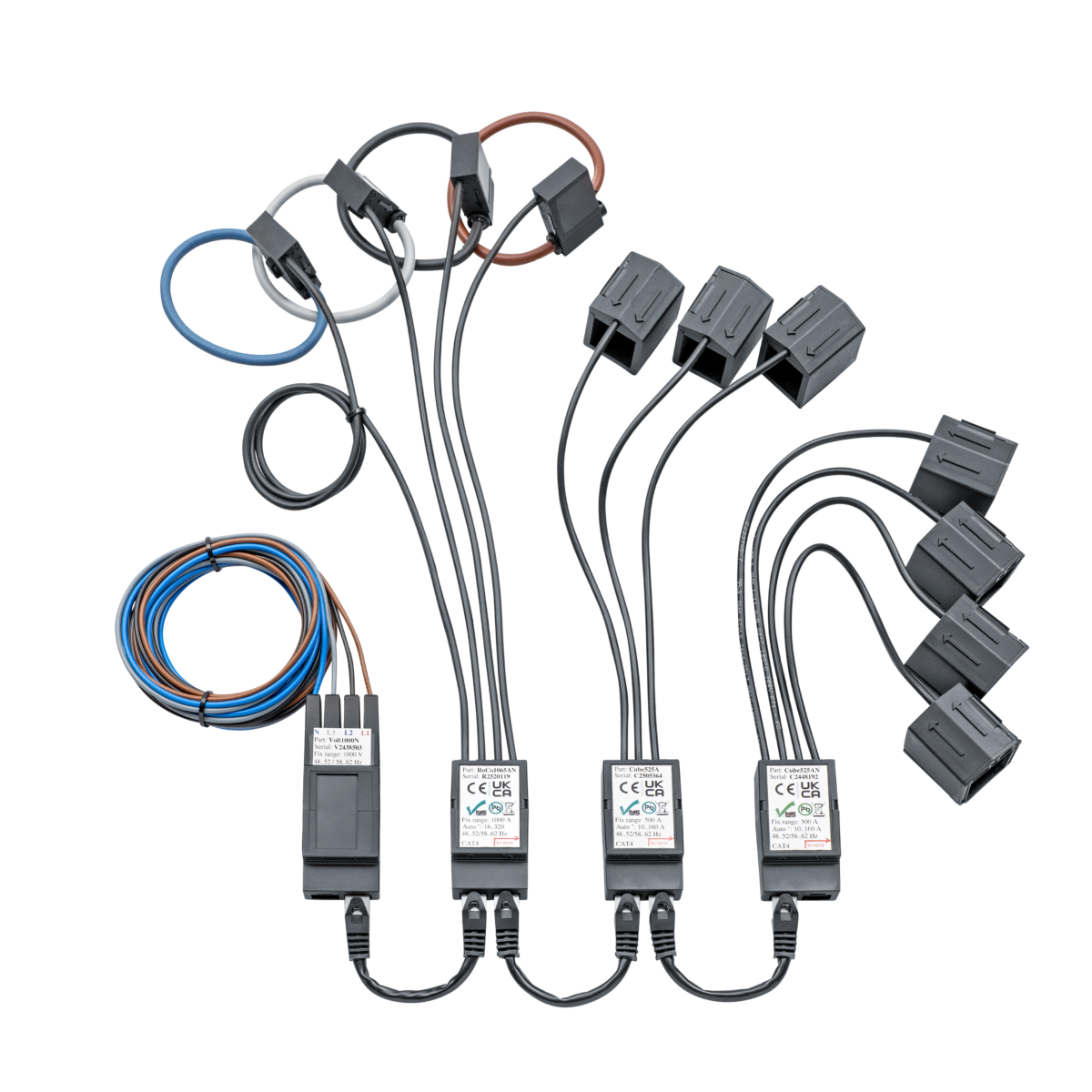
The Volt 1000N’s modular design also allows it to work in tandem with optional current sensor modules, forming a complete multi-point power monitoring system as needs grow.
Range features
A high level overview of what this range offers
- Four-phase voltage measurement (L1, L2, L3 + N) – Provides comprehensive monitoring of all three line voltages and neutral, ensuring a complete view of network conditions
- Built-in touch display for readings – On-device panel allows convenient local access to voltage and system data without extra instruments, simplifying on-site diagnostics
- Modbus RTU communication – RS-485 interface (Modbus slave) enables straightforward integration into PLCs, SCADA or BMS systems for real-time data and remote configuration
- Automatic threshold alarms – Continuously monitors voltage levels (and connected current/phase metrics) and triggers visual LED alerts or digital outputs when limits are exceeded, helping operators respond immediately to anomalies
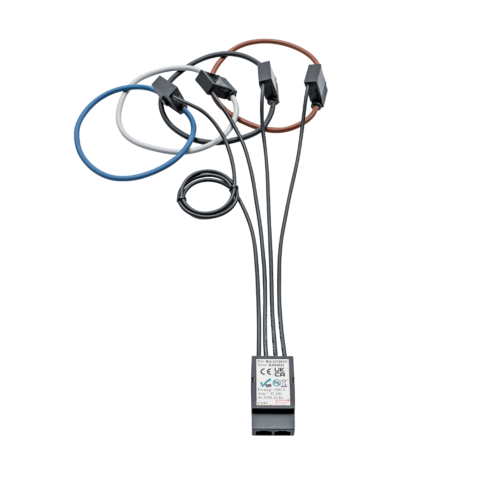
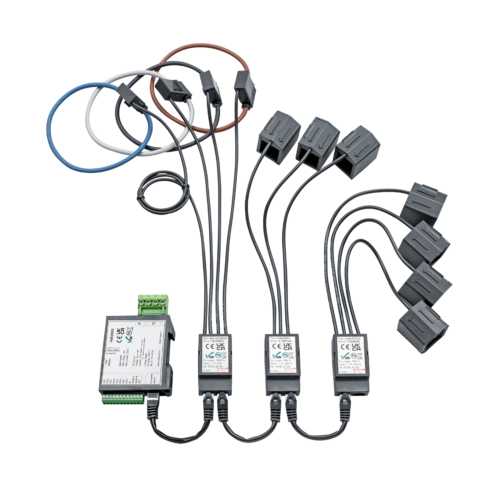
- Support for cascaded current sensors – Can link with up to 15 Rogowski coil current modules, making downstream current measurements transparently available for combined voltage/current analysis and power calculations
- Magnetic DIN-rail mounting – Attaches securely to standard 35 mm DIN rails with a magnetic mount, enabling quick installation or retrofit without drilling and minimal downtime
- Compact retrofit-friendly design – Slim module fits in confined transformer cabinets and existing enclosures, allowing upgrades of older substations to modern monitoring with no major modifications
- Rugged industrial build – Durable construction (encapsulated electronics) for reliable operation in harsh substation environments, with low maintenance needs over a long service life
- Real-time data insight – Delivers up-to-the-moment voltage readings and phase status, supporting faster decision-making and compliance with grid quality requirements
Downloads
for Volt 1000N 3-Phasen Spannungsmessgerät für Energieverteilungssysteme
What’s in this range?
All the variants in the range and a comparison of what they offer
| Specification | Value |
|---|---|
Phases monitored | 3-phase + Neutral (four-wire, L1, L2, L3 with N reference) |
Nominal voltage (L-L) | 400 VAC three-phase (230 VAC phase-to-neutral) |
Voltage measurement range | 0 … 440 VAC (phase-to-phase), 50/60 Hz network |
Measurement accuracy | ~1% FS (voltage) – for non-revenue grid monitoring |
Frequency monitoring | Yes, mains frequency measurement (45 – 65 Hz range) |
Communication interface | RS-485 (Modbus RTU slave, 120 Ω termination internal) |
Expansion bus | RJ45 patch port for daisy-chaining up to 15 current modules |
Supply voltage | 24 V DC (external supply, typical) |
Power consumption | < 5 W (low-power electronics module) |
Alarm indication | LED indicator for threshold breach; 1× digital output for remote alarm signaling |
Local display | Integrated touch-sensitive panel with LCD readout |
Mounting | 35 mm DIN rail (EN 60715 compliant); magnetic mounting support |
Operating temperature | –20 °C to +70 °C (suitable for unheated substations) |
Protection & safety | Over-voltage category CAT III (600 V) for direct grid connection; robust potted design for moisture and dust resistance |
Dimensions (W×H×D) | Approx. 54 mm × 90 mm × 58 mm (DIN rail enclosure) |
Standards compliance | CE marked; designed to meet EN 61010 and IEC 61000 (EMC) requirements |
FAQs
for Volt 1000N 3-Phasen Spannungsmessgerät für Energieverteilungssysteme
The Volt 1000N connects directly to a three-phase four-wire system. It has inputs for L1, L2, L3 and the neutral, and is designed for low-voltage networks (nominal 230 V AC phase-to-neutral / 400 V AC phase-to-phase). It will measure each phase’s voltage relative to neutral in real time. (For medium-voltage systems, it would be used in conjunction with appropriate voltage transformers, but no transformer is needed for standard 400 V distribution levels.)
By itself the unit measures only voltages (and calculates frequency and phase angles), but it is part of a modular system. It can be expanded with dedicated current sensor modules (Rogowski coil based ammeters). When current modules are cascaded with the Volt 1000N, the combined system can compute current on each phase as well as derived power parameters like kW, kVA, power factor, and energy consumption. The Volt 1000N essentially acts as the master voltage unit providing reference voltage data to all linked current sensors for complete power monitoring.
This device has built-in threshold monitoring for key parameters. You can define trigger limits for voltage levels (and for current or phase angle when using the expansion modules). If a threshold is exceeded – for example, an over-voltage or significant phase imbalance – the Volt 1000N will immediately indicate an alarm. It flashes an on-board LED to provide a visual alert and also activates a digital alarm output that can be tied into a PLC or alarm system. Simultaneously, over Modbus it can flag the alarm condition so that the central SCADA or control system is notified in real time.
Integration is done via the Volt 1000N’s RS-485 port using the Modbus RTU protocol. The device operates as a Modbus slave node. In practice, you assign it a Modbus address on your RS-485 network, and your SCADA/PLC (the Modbus master) polls it for data. The unit provides registers for phase voltages, frequency, alarm status, etc., which can be read at intervals as needed. Setting it up is straightforward – it uses industry-standard Modbus commands, and you can also configure parameters like baud rate and device ID to match your network. This allows the Volt 1000N’s real-time data and alerts to be seamlessly pulled into your supervisory system for logging or automated responses.
Yes – the Volt 1000N was developed with retrofit installations in mind. Its compact, modular design and magnetic DIN-rail mounting make it very easy to install inside existing transformer station cabinets or distribution boards. You typically only need to attach the unit to the DIN rail and connect the phase and neutral wires to its terminals. There’s no need to replace the whole panel or take the substation out of service for long periods – the quick installation minimises downtime. By retrofitting a Volt 1000N, operators can upgrade an older passive substation into a smarter, monitored station capable of providing real-time voltage data and alarms.
Absolutely. While it excels at retrofits, the Volt 1000N is equally suited for new builds. In new network projects, it can be incorporated from day one to provide continuous voltage and power quality monitoring. This ensures that even newly commissioned transformer stations meet modern grid management requirements from the start. Its modular expansion capability means you can deploy just the voltage monitor initially and easily add current sensing modules later if the installation’s monitoring needs grow (for example, if new feeders or renewable generation sources are added).
The device is designed for industrial and utility environments. It operates reliably across a broad temperature range (approximately –20 °C to +70 °C), covering the conditions of typical street-level substations or switchgear cabinets that might get very cold in winter and hot in summer. The electronics are encased in a protective housing (with critical components potted in resin), guarding against dust, humidity and vibration. This rugged design means the Volt 1000N requires virtually no maintenance once installed – it’s built to function 24/7 in tough conditions without frequent calibration or attention.
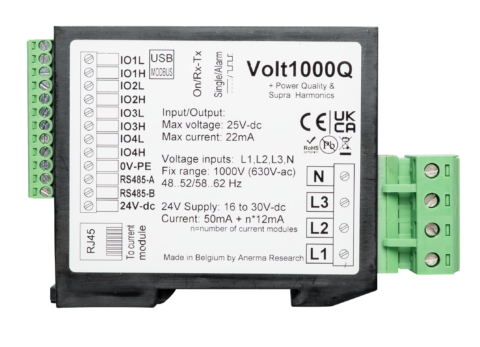
Yes, the Volt 1000 series has a couple of versions to suit different needs. The standard Volt 1000N features the built-in display and is focused on voltage monitoring. Another variant, Volt 1000S, is a successor model that offers additional I/O capabilities. The Volt 1000S has four configurable inputs/outputs and a USB interface for configuration or firmware updates, and comes in an even more compact casing (occupying only 20 mm on the DIN rail). Both versions are fully compatible with the modular current sensor units and share the same core voltage measurement functionality. The choice between them depends on whether you need the extra I/O and features (in which case the Volt 1000S is ideal) or prefer the convenience of an integrated display (which the Volt 1000N provides). Either way, you can mix and match within the Volt 1000 family as required, since they communicate over the same interface to the rest of the system.
One Volt 1000N can serve as the hub for up to 15 additional measurement modules in a daisy chain (this typically refers to current sensor modules used for monitoring multiple feeders or phases). In practice, you would link a series of Rogowski-coil modules (for example, one set of current sensors per feeder or per phase if needed) to the Volt 1000N using the built-in cascade port and standard patch cables. The Volt 1000N will then feed each connected module with the necessary reference voltage data and collect their measurements. This modular expandability means a single Volt 1000N can form a comprehensive monitoring system covering numerous circuits in parallel – useful for larger substations or installations where you want to monitor several points with one coordinated system.