Current measuring device RoCo1065Ax / Cube 525Ax
- Technology
- Modular power meters
- Partner
- Acal BFi
Modern utilities and industrial operators need reliable ways to monitor feeder currents without overhauling existing equipment.
The RoCo1065Ax and Cube 525Ax current measuring modules provide a practical solution by clipping around live cables and instantly measuring three-phase currents (plus neutral if required). These modules are purpose-built for retrofit applications – for example, upgrading ageing transformer stations to track new loads like EV chargers and heat pumps.
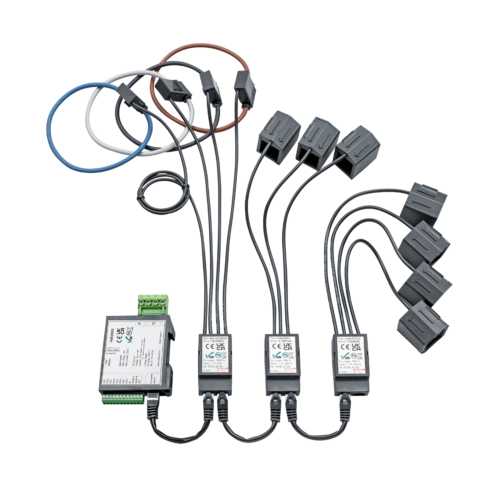
Each module operates stand-alone as a Modbus RTU device supplying real-time current data, or it can work in tandem with a voltage unit to calculate complete power and energy metrics. With simple daisy-chain connectivity, up to 20 modules can be linked to cover 20 of feeders via a single communication link.
The result is a scalable, multi-channel power monitoring system that helps grid operators and facility managers gain precise insight into network conditions in near real time, all while fitting into tight spaces and existing setups with ease.

Range features
A high level overview of what this range offers
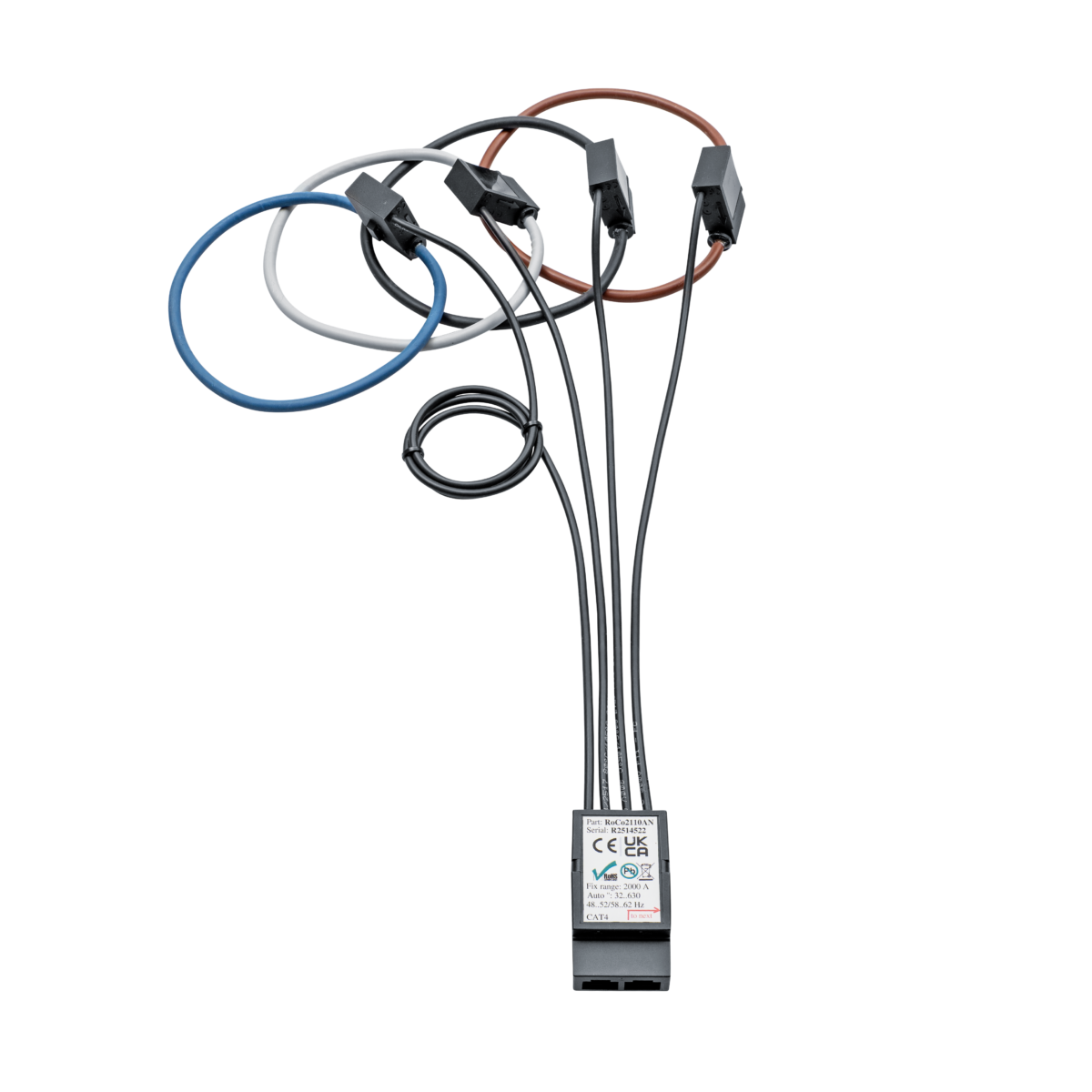
- Non-intrusive Rogowski coil design – Easy retrofits: Flexible coil sensors wrap around existing conductors without disconnecting them, allowing quick installation on live circuits and eliminating downtime.
- Compact “Cube” sensor option – Fits tight spaces: A small cube-shaped current sensor handles cables up to 25 mm diameter, ideal when switchgear space is limited, while still measuring high currents (up to ~500 A).
- 3-phase or 4-phase measurement – Full feeder coverage: Available in three-channel and four-channel versions to monitor three phases alone or with neutral, so both 3-wire and 4-wire circuits can be instrumented as needed.
- Modbus RTU connectivity – PLC/SCADA integration: Each module communicates via RS-485 Modbus RTU as a slave device, making it straightforward to integrate into existing automation systems for remote data collection and control.
- Cascadable up to 20 modules – Scalable monitoring: Multiple current modules can be daisy-chained with simple patch cables (RJ45), allowing one base unit to gather data from up to 20 feeders (mixed RoCo and Cube units) over a single interface. This minimises wiring complexity and centralises measurement for an entire site.
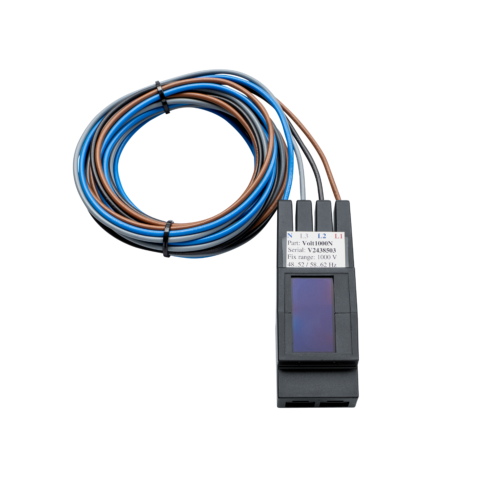
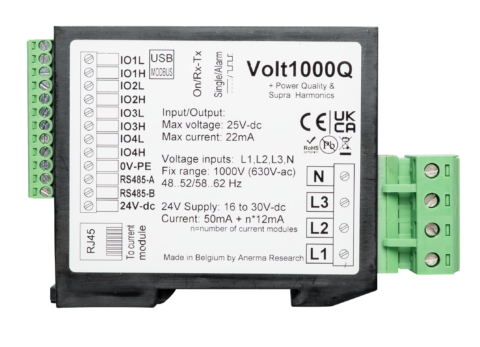
- Volt1000 compatibility – Complete power analysis: When paired with a Volt1000 voltage measuring unit, the system calculates per-phase voltage, current, real power, reactive power, power factor, and energy values for each feeder. This gives a full power meter solution for grid compliance and energy management.
- Local display and USB access – On-site convenience: Measured values can be viewed on the connected Volt1000’s touch display for quick checking. A built-in USB interface on the module allows direct PC connection for configuration or reading measurements using provided software, aiding commissioning and troubleshooting.
- Magnetic DIN-rail mounting – Fast installation: The modules attach securely to standard DIN rails using magnets instead of screws or clips, enabling rapid, tool-free mounting and easy repositioning if needed – particularly useful in retrofit scenarios.
- Programmable thresholds (via base unit) – Proactive alerts: Integrated threshold monitoring (through the Volt1000 controller) can flag over-current conditions, voltage anomalies, or phase imbalance. This helps operators detect critical grid situations early and implement control measures within mandated response times.
- Robust and maintenance-free – Industrial reliability: Engineered for substation and industrial environments, the modules feature a durable design with no moving parts. They offer long-term stability and minimal maintenance requirements, ensuring dependable operation in the field.
What’s in this range?
All the variants in the range and a comparison of what they offer
| Specification | RoCo1065Ax series | Cube 525Ax series |
|---|---|---|
Sensor type | Flexible Rogowski coil sensors (wrap-around) | Compact Rogowski coil sensors (fixed loop) |
Max. measurable current (AC) | ~1000 A AC (per phase) | ~500 A AC (per phase) |
Cable aperture size | Up to Ø 65 mm (large conductors) | Up to Ø 25 mm (small conductors) |
Number of phases per module | 3-phase or 3-phase + Neutral (optional 4th coil) | 3-phase or 3-phase + Neutral (optional 4th coil) |
Communication interface | RS-485, Modbus RTU (up to 115 kbps) | RS-485, Modbus RTU (up to 115 kbps) |
Module chaining capacity | Up to 15–20 modules on one bus (addressable) | Up to 15–20 modules on one bus (addressable) |
Power supply | 24 V DC (nominal), via bus connector or external feed | 24 V DC (nominal), via bus connector or external feed |
Mounting method | Magnetic attachment to DIN rail | Magnetic attachment to DIN rail |
Operating temperature range |
|
|
Accuracy class / resolution |
|
|
Dimensions | Rogowski coil: flexible loop for 65 mm cable; compact module fits in control cabinet | Cube sensor unit: approx. 25 mm opening; compact module fits in tight spaces |
Compatibility | Works stand-alone or with Volt1000 series voltage unit for full power metering | Works stand-alone or with Volt1000 series voltage unit for full power metering |
Note: “Ax” denotes available versions with (AN) or without (A) neutral measurement channel. Specifications are for AC current measurement in 50/60 Hz power systems. For detailed accuracy and environmental specifications, refer to the official datasheet.
FAQs
for Current measuring device RoCo1065Ax / Cube 525Ax
With a single voltage base unit, you can cascade up to about 15–20 current modules in one chain. This means a single Modbus connection can gather data from up to 15–20 separate three-phase circuits (each module measuring one feeder). In practice, one Volt1000 controller can handle monitoring for up to 20 outgoing feeders. For even larger systems, two base units on separate Modbus lines could be used, effectively doubling the number of feeders covered.
Yes. The RoCo1065Ax and Cube 525Ax modules are fully interoperable on the same daisy-chain bus. You can deploy a mix of Rogowski coil modules and cube modules as needed for different feeder sizes or space constraints. The Modbus addressing and data format are uniform, so the base unit and network see a seamless multi-module system regardless of the sensor type combination.
Both module types perform the same function of measuring multi-phase AC current, but they are designed for different physical scenarios. RoCo1065Ax modules use flexible Rogowski coils that wrap around larger conductors (up to 65 mm diameter) and can handle higher currents (around 1000 A). In contrast, Cube 525Ax modules use a rigid small-form sensor (cube shape with 25 mm aperture) intended for tighter spaces or smaller cables, with a current range up to roughly 500 A. Functionally, they are identical in terms of outputs and interface – the choice mainly depends on the size of the cables and available space in the installation.
It depends on what you need to measure. The RoCo/Cube modules can operate stand-alone – each will measure currents on its connected phases and provide those readings directly over Modbus to a PLC or SCADA system. In stand-alone use, you get current magnitude values per phase (useful for load monitoring, imbalance detection, etc.). However, if you want to obtain full power and energy measurements (like calculating kW, kVA, power factor, and kWh), then a Volt1000 voltage measuring unit is required in the chain. The Volt1000 supplies the reference voltage data to the current modules so that each module can compute real-time power values for its particular feeder. In summary: for currents only, the modules alone suffice; for complete power analysis, a voltage unit is needed as the first module in the chain.
Each module has an RS-485 port and is designed to be daisy-chained using standard shielded patch cables. One end of the chain connects to your Modbus RTU master (for example, a SCADA RTU or PLC) and the current modules attach one after another. The first module in line (often the Volt1000 if present, or the first RoCo/Cube if used alone) acts as the starting point. All modules are Modbus slave devices with individual addresses. Your Modbus master polls the chain, and thanks to the built-in coordinator logic (in the Volt1000 or first module), it can retrieve measurements from any module in the cascade with a single link. This architecture means you only need one cable run back to the control system, even if you are monitoring dozens of currents. Data is transmitted in real time over Modbus, so you can see near-instantaneous values for each phase current (and voltage/power if applicable) in your software.
Absolutely. These modules were specifically designed with retrofit applications in mind. The Rogowski coil of the RoCo unit can be opened or flexed around an existing bus bar or cable, so you don’t have to cut or disconnect any live conductor. The Cube unit is very compact and can be slipped around smaller cables where space is limited. Both types attach via magnetic mounts, avoiding drilling or extensive panel modifications. In practice, installers can fit the sensors into an existing low-voltage distribution cabinet or transformer station in a short time. This makes it feasible to upgrade an old substation with modern monitoring capabilities without expensive rebuilds or extended outages.
The modules use high-resolution ADCs and true RMS measurement techniques to capture AC current waveforms. They are capable of measuring from very low currents up to their maximum range with reliable accuracy for typical power network frequencies (50 Hz or 60 Hz). The exact accuracy class isn’t explicitly stated in the brief, but they are designed for utility monitoring needs – typically on the order of 1% accuracy or better for the nominal range. Importantly, all phase currents are sampled simultaneously across modules, ensuring synchronous measurements that are suitable for power calculations and grid analysis. The system updates continuously, allowing detection of changes in loading within seconds; it also meets the requirement to deliver aggregated data (for example, 5-minute interval values) to higher-level systems as demanded by grid regulation.
Threshold or limit monitoring is managed via the Volt1000 controller unit when it’s part of the system. The base unit continuously compares the measured values (currents, voltages, phase angles, etc.) against configured setpoints. If an overload or abnormal condition is detected – for instance, a feeder current exceeding its allowable limit or a phase failure – the system can trigger an alarm output or flag the event over Modbus. The Volt1000 has configurable I/O channels (on certain models) that can be used to drive alarm relays or indicators. In a stand-alone scenario without the Volt unit, the current modules themselves do not have built-in alarm relays, but an external PLC or SCADA can easily implement threshold checks by reading the live data and issuing alerts or control commands as needed.
Yes, that is one of the key applications. Section 14a EnWG requires distribution network operators to monitor and manage controllable loads (like EV chargers, heat pumps, etc.) by obtaining near real-time feeder data. The RoCo/Cube modular current sensors, used together with the Volt1000 voltage unit, form a comprehensive power monitoring system that can be retrofitted into local substations. They provide feeder-specific voltage and current measurements within the mandated intervals (e.g. five-minute updates or faster), enabling the detection of grid stress conditions. By deploying these modules across all outgoing feeders of a transformer station, an operator gains the granular visibility needed to document grid conditions and intervene (for example, throttling loads or switching configurations) in accordance with the regulation. Essentially, the system delivers the precise, timely data backbone required for a smart grid implementation under 14a EnWG, without having to replace existing infrastructure.