610E-K-CE High Voltage Amplifier 10 kV, 2 mA
- Technology
- High voltage amplifiers and piezo drivers
- Partner
- Trek / Advanced Energy
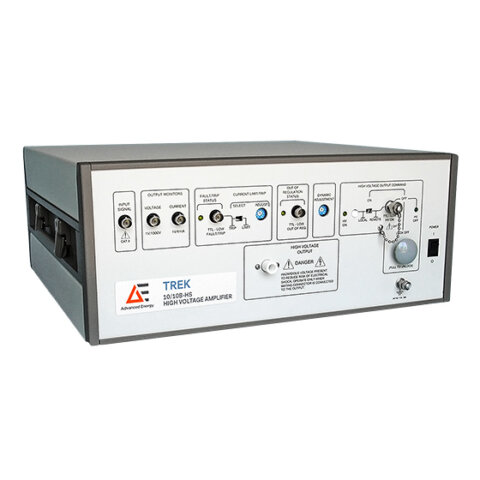
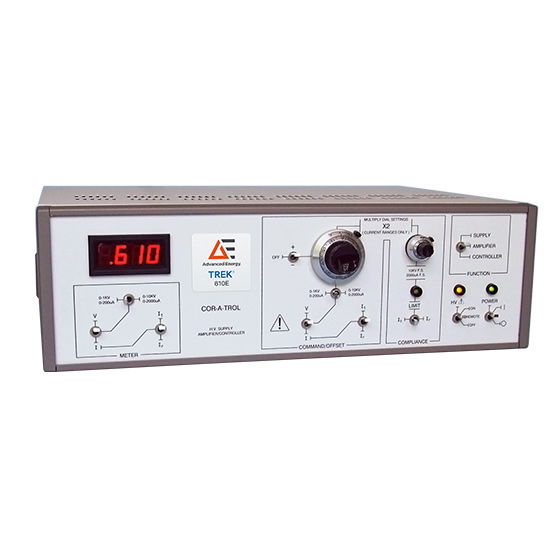
The TREK 610E-K-CE high voltage amplifier is a bench-top system that outputs up to ±10 kV at ±2 mA, providing a stable high-voltage source for precision applications. It features a versatile multi-mode design, allowing it to operate as a voltage amplifier, a high-voltage power supply, a current source, or a controller – all in one unit. A switchable gain (100 V/V or 1000 V/V) lets you select between two output ranges (0 to ±1 kV or 0 to ±10 kV), offering fine resolution at lower voltages or full 10 kV capability when needed. Designed for engineers and researchers, this amplifier excels in tasks like closed-loop charge control, electrophotographic process research, high-voltage insulation testing, and dielectric material evaluation. The four-quadrant output stage can both source and sink current, making it well-suited for driving capacitive loads (e.g. piezoelectric devices or electrostatic actuators) without performance loss. A closed-loop feedback architecture ensures high accuracy and long-term DC stability of the output, while built-in safety features such as short-circuit protection and remote high-voltage enable control support safe operation in laboratory or industrial settings.
Range features
A high level overview of what this range offers
- Multi-mode operation – One instrument can function as a high-voltage amplifier, reference supply, transconductance amplifier, or controller, providing exceptional versatility for different use cases.
- Four-quadrant output – Capable of both sourcing and sinking current, which is ideal for driving capacitive or reactive loads (e.g. actuators, electrostatic devices) without compromising stability.
- DC-stable, closed-loop design – Maintains high accuracy and a stable output over time, supporting precision control in sensitive high-voltage applications with minimal drift.
- Short-circuit protection – Inherent overload and short-circuit safeguards protect the amplifier and connected equipment from damage in the event of a fault or misuse.
- Low noise output – Produces very low output ripple and noise (on the order of millivolts), enabling precise and ultra-stable voltage or current delivery for critical experiments and measurements.
- Calibrated for accuracy – Each unit is provided with a NIST-traceable calibration certificate, giving immediate confidence in the output accuracy and meeting rigorous quality requirements.
- CE compliant – Fully compliant with CE safety and EMC standards, ensuring the device meets international requirements for use in professional lab and industrial environments.
Downloads
for 610E-K-CE High Voltage Amplifier 10 kV, 2 mA
What’s in this range?
All the variants in the range and a comparison of what they offer
| Specification | Value |
|---|---|
Output Voltage Range | 0 to ±1 kV or 0 to ±10 kV (switch selectable) |
Output Current Range | 0 to ±0.2 mA or 0 to ±2 mA (switch selectable) |
Slew Rate (10–90% rise) |
|
Small-Signal Bandwidth (-3 dB) | DC to 10 kHz |
Large-Signal Bandwidth (-3 dB) | DC to > 1.2 kHz |
Large-Signal Bandwidth (1% dist.) | DC to > 600 Hz |
Settling Time (to 1% final) | < 1 ms (for a 0 to 10 kV step change) |
Voltage Gain | 100 V/V (for ±1 kV range); 1000 V/V (for ±10 kV range) |
Transconductance Gain | 20 µA/V (200 µA range); 200 µA/V (2000 µA range) |
DC Offset Voltage | < 2 V |
Output Noise | < 0.7 V RMS (20 kHz measurement bandwidth) |
Input Signal (for full output) | ±10 V (produces max rated output) |
Output Polarity | Bipolar, four-quadrant (positive/negative output, source & sink) |
Dimensions (H × W × D) | 140 mm × 432 mm × 374 mm |
Weight | 10.6 kg |
FAQs
for 610E-K-CE High Voltage Amplifier 10 kV, 2 mA
This high-voltage amplifier supports six selectable modes of operation. It can function as a standard high-voltage amplifier (with either 100 V/V or 1000 V/V gain settings), as a high-voltage reference supply, as a transconductance amplifier (voltage-to-current converter), as a precision current supply, or as a high-voltage controller. Each mode changes how the device regulates output: for example, in supply mode you adjust the output via a front panel dial, whereas in amplifier mode the output faithfully amplifies an external signal. This multi-mode capability allows one instrument to serve many roles in the lab, from generating steady DC high voltages to amplifying dynamic signals or controlling current in a circuit.
The 610E-K-CE includes a front-panel range selector that lets you choose the output voltage range. Internally, it changes the amplifier gain: in the low range mode, the gain is 100 V/V (producing up to ±1 kV output for a ±10 V input), and in the high range mode the gain is 1000 V/V (producing up to ±10 kV output for the same input). By toggling this range switch, you trade off maximum voltage for finer control resolution. This means you can work with delicate low-voltage experiments in the ±1 kV range and easily switch to the full ±10 kV range when higher voltage is required, all on the same device.
“Small-signal bandwidth” refers to the frequency range over which the 610E-K-CE can faithfully amplify small amplitude signals (typically measured at the –3 dB point for a very small output swing). For this amplifier, the small-signal bandwidth extends up to approximately 10 kHz, meaning it can handle waveforms or rapid voltage changes in that frequency range as long as the amplitude is small. Large-signal bandwidth, on the other hand, describes the bandwidth when the amplifier is driving a substantial fraction of its full output voltage (i.e. high-voltage swings). In this case, the bandwidth is lower – roughly up to about 1.2 kHz at full ±10 kV output (for –3 dB attenuation). In practical terms, large-signal bandwidth tells you how fast you can swing the output at high voltage levels. For even stricter linearity (e.g. keeping distortion under 1%), the effective large-signal bandwidth is about 600 Hz. In summary, the 610E-K-CE can output very fast changes for small voltages, but at the maximum 10 kV amplitude the speed is limited to the kHz range.
Yes. The amplifier is designed as a four-quadrant output device, meaning it can both source and sink current across the positive and negative voltage range. This capability is particularly important for driving capacitive or other reactive loads (such as piezoelectric transducers or electrostatic plates) which can source current back into the amplifier when the voltage changes. The 610E-K-CE’s output stage remains stable with capacitive loads and can actively absorb return energy, allowing it to drive such loads without oscillation. In practical use, this means you can connect capacitors, piezo devices, or high-voltage actuators directly to the amplifier and it will respond reliably to both charge and discharge them as needed by your waveform, maintaining control in all four quadrants of operation.
The 610E-K-CE incorporates several safety and protection features. Firstly, it has an automatic short-circuit protection that limits the output current in the event of an arc or direct short across the output, preventing damage to the unit and the device under test. The amplifier is also CE compliant, which means it meets strict safety standards (including insulation, grounding, and EMC requirements) for handling high voltage. Additionally, the front panel includes a safety interlock or high-voltage enable switch – often a keyed switch or a push-button – so that high voltage output can be disabled quickly or controlled remotely by a TTL signal. There is also an output polarity selector with an Off position, allowing the output to be completely de-energized without powering down the whole unit. Together, these features ensure that the operator has multiple layers of protection and control when working with the ±10 kV outputs.
The 610E-K-CE is quite responsive for a high-voltage device. Its slew rate is greater than 35 V/µs (35 volts per microsecond), which is a measure of how quickly the output can change. To put this in perspective, a 10 kV step will transition in a few hundred microseconds given that rate. More formally, the settling time to about 1% of a new setpoint for a full 0 to 10 kV step is under 1 millisecond. This fast response is advantageous when you need the high voltage to follow rapid setpoint changes or when generating fast voltage waveforms. It ensures that even when you apply a sudden change to the input signal or adjust the output dial significantly, the amplifier’s output will reach the new desired voltage almost immediately (within a thousandth of a second for a full-scale change).
This amplifier is used in a variety of specialized engineering and research applications. For example, in closed-loop charge control experiments, it can supply a controlled high voltage to charge materials or components while monitoring and maintaining the charge level. In electrophotographic research (such as developing and testing components for laser printers or photocopiers), its ability to provide very stable high voltages is essential for charging and transferring toner. The 610E-K-CE is also commonly used for insulation testing and dielectric material evaluation – it can apply a high DC bias or waveform to a material sample and help assess its insulating properties or breakdown voltage. Additionally, any application requiring a precise high-voltage bias or drive can benefit: examples include driving piezoelectric actuators, electrostatic deflection plates, ion beam steering electrodes, or even as a programmable high-voltage source in calibration labs. In essence, whenever a stable, controllable high voltage up to 10 kV is needed with low noise and good accuracy, this amplifier is a strong candidate.
The 610E-K-CE is engineered for high accuracy, with a closed-loop feedback system that continuously monitors and corrects the output to match the desired setpoint. The device has a specified voltage gain accuracy (for example, better than 0.3% of full scale in amplifier mode), meaning the output will closely correspond to the input command. To ensure this level of precision, each unit is delivered with a NIST-traceable calibration certificate. This means the output measurement and reading have been calibrated against standards from the National Institute of Standards and Technology, so you can trust the voltage and current readings it provides. Over time, like all precision instruments, it may require recalibration – and the manufacturer provides recommended calibration intervals and services to keep the amplifier within spec. In daily operation, the low drift and DC stability of the design help maintain accuracy without frequent adjustments. Essentially, from day one you receive it, the amplifier’s accuracy is verified, and its design keeps it reliably on target for voltage and current output values.