609E-6-H-CE High Voltage Amplifier 4 kV, 20 mA
- Technology
- High voltage amplifiers and piezo drivers
- Partner
- Trek / Advanced Energy
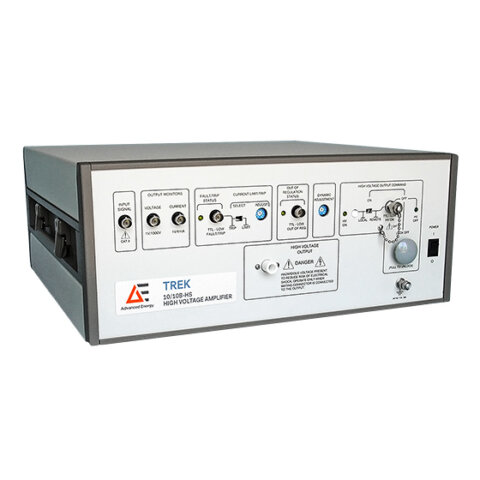
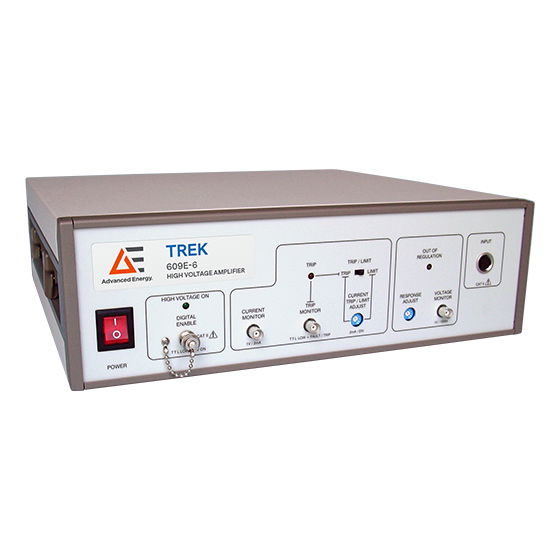
The TREK 609E-6-H-CE high-voltage amplifier is a specialised power instrument designed for engineers and researchers who need precise high-voltage outputs. It can supply bipolar voltages up to ±4 kV with currents up to ±20 mA, making it ideal for tasks like biasing electrostatic devices, driving ion optics in mass spectrometers, or testing dielectric materials. The all-solid-state design offers a wide bandwidth and high slew rate, enabling it to reproduce fast-changing or AC waveforms reliably. Thanks to a four-quadrant output stage, the amplifier can both source and sink current, so it drives capacitive or reactive loads just as effectively as resistive loads. Users can configure the input as non-inverting, inverting, or differential, giving flexibility to interface with different signal sources or control systems. Built-in safeguards such as an adjustable current limit/trip and short-circuit protection help protect both the connected load and the amplifier itself during operation. Each unit is provided fully calibrated (with a traceable certificate) and CE compliant, ensuring confidence in accuracy and adherence to high safety standards.
Range features
A high level overview of what this range offers
- Four-quadrant output design – Sinks and sources current, enabling stable operation with capacitive and other reactive loads across the full voltage range.
- Closed-loop control – Maintains high output accuracy and stability through a feedback-regulated design, ensuring precise voltage delivery.
- Adjustable current limit & trip – User-selectable current limiting or automatic trip-off protects the load and the amplifier from over-current or short-circuit conditions.
- Local and remote HV control – High-voltage output can be turned on/off via front-panel switch or an external TTL logic signal, allowing safe integration with interlock systems and remote operation.
- DC-stable, low-noise operation – Provides very steady DC outputs with minimal ripple, which supports ultra-precise high-voltage biasing in sensitive applications.
- High slew rate – Rapid voltage rise capability (>150 V/µs) delivers fast response for dynamic signals and pulsed waveforms.
- NIST-traceable calibration – Each amplifier is delivered with a calibration certificate traceable to national standards, verifying performance and measurement accuracy.
- CE compliant design – Meets stringent European safety and EMC standards, making it suitable for use in regulated industrial and laboratory environments.
Downloads
for 609E-6-H-CE High Voltage Amplifier 4 kV, 20 mA
What’s in this range?
All the variants in the range and a comparison of what they offer
| Specification | Value |
|---|---|
Output Voltage Range | 0 to ±4 kV DC or peak AC |
Output Current Range | 0 to ±20 mA DC or peak AC |
Output Power | 80 W |
DC Voltage Gain | 1000 V/V (fixed) |
Input Voltage Range | 0 to ±4 V (for full output) |
Input Impedance | 25 kΩ (non-inverting); 50 kΩ (inverting/differential) |
Slew Rate (10% – 90%) |
|
Large-Signal Bandwidth (-3 dB) | DC to > 13 kHz |
Small-Signal Bandwidth (-3 dB) | DC to > 35 kHz |
Settling Time (0 to 4 kV step) | < 150 µs |
Output Noise (rms) | < 50 mV rms (full output, typical) |
Accuracy | Better than ±0.1% of full scale |
HV Output Connector | Alden high-voltage connector (panel mount) |
Monitor & Control Ports | BNC terminals for voltage monitor, current monitor, remote HV on/off, and status outputs |
AC Supply (609E-6-H-CE) | 180 to 250 VAC, 48 to 63 Hz (single-phase mains) |
Dimensions (H × W × D) | 140 × 432 × 439 mm (5.5″ × 17″ × 17.25″) |
Weight | 13.2 kg (29 lb) |
Operating Temperature | 0 °C to 40 °C |
FAQs
for 609E-6-H-CE High Voltage Amplifier 4 kV, 20 mA
This amplifier is designed to drive a wide range of load types, including highly capacitive or reactive loads as well as resistive loads. Its four-quadrant output stage allows it to both source and sink current, which means even if your load feeds energy back (as capacitive and inductive loads do), the 609E-6 can handle it and maintain stable output voltage. This makes it suitable for driving things like electrostatic chucks, piezo actuators, or any load with significant capacitance or inductance without performance loss.
The 609E-6 amplifier uses a fixed gain of 1000 V/V. In practice, that means for every 1 volt you apply to its input, it produces 1000 volts at the output. To reach the full ±4 kV output range, you would drive the amplifier with a ±4 V analog signal (which can be supplied from a function generator, DAC, or other source). The amplifier can be wired in different configurations (non-inverting, inverting, or differential), so you can choose the best way to feed your control signal. For example, in non-inverting mode a 0 to +4 V input yields 0 to +4 kV output, whereas the inverting mode would invert the input polarity. The differential mode allows you to drive the amplifier with two complementary signals (Va and Vb), effectively amplifying the difference (Vout = 1000 × (Va – Vb)). This flexibility makes it easy to integrate the amplifier with various control systems and signal sources.
Yes, the 609E-6 is DC-stable, which means it can hold a constant high-voltage DC output indefinitely. It can also reproduce AC waveforms and fast voltage transitions up to a notable frequency. The amplifier’s bandwidth reaches approximately 13 kHz (-3 dB) for large-swing signals (near the full ±4 kV output), which covers many low- to mid-frequency AC applications. For smaller amplitude signals, the bandwidth extends even further (over 35 kHz in small-signal terms). In practical terms, you could use this amplifier to generate high-voltage sine waves, square waves, or pulses in the audio-frequency range (kHz range) without significant distortion. Its slew rate (>150 V/µs) and a settling time on the order of 150 µs for a full 0-to-4 kV step ensure it responds quickly to changes, making it suitable for a variety of dynamic high-voltage tests and simulations.
The 609E-6 incorporates several safety and protection features to safeguard both your equipment and the amplifier itself. First, it has an adjustable current limit/trip: you can set the maximum output current (up to 20 mA) via a front-panel knob. If the load tries to draw more than the set limit, the amplifier can either limit the current to that value or shut down (trip), depending on the mode you select. This prevents excessive current from flowing into your device under test. The output stage is also short-circuit protected, meaning if the output is accidentally shorted or a sudden fault occurs, the amplifier will tolerate it (within the current limits) without damage. Additionally, there are status indicators and TTL output signals for fault conditions: an “Out of Regulation” indicator lets you know if the amplifier can’t maintain the commanded output (for example, if it hits the current limit), and a “Trip Status” indicator will light if the high-voltage output is disabled due to a fault (such as over-current or the removal of the safety cover). These features collectively ensure that the amplifier can shut itself down gracefully or limit output when something goes wrong, rather than failing catastrophically or damaging your load.
The 609E-6 provides both local and remote high-voltage on/off controls. Locally, there is a front-panel HV ON/OFF push-button that lets you enable or disable the high-voltage output manually. For remote control, the amplifier has a TTL logic input that serves as a remote interlock or on/off signal. By default, a TTL "low" (0 V) applied to this input will enable the high-voltage output, and a TTL "high" (5 V) will disable the output (this logic scheme is a typical safety convention). Using this remote HV control, you can integrate the amplifier into a larger system or safety interlock chain. For example, you might connect it to a lab safety switch, so that opening a door or removing a protective cover sends a TTL high to the amplifier to immediately shut off the high voltage. It’s a very useful feature for ensuring operator safety and for coordinating the amplifier with other equipment in automated test setups.
Yes, the amplifier includes convenient monitor outputs for both voltage and current. On the front or rear panel (depending on the model layout), you will find BNC connectors that provide low-voltage analog signals proportional to the high-voltage output and the output current. The voltage monitor typically gives a scaled-down replica of the high-voltage output (for instance, 1/1000 of the actual output voltage, so a 4 kV output would read as 4 V on the monitor). Similarly, the current monitor outputs a voltage proportional to the load current (for example, 0.1 V per mA of output current, as a hypothetical scale). By connecting these monitor BNCs to an oscilloscope, multimeter, or data acquisition system, you can observe the amplifier’s behavior in real time without needing a high-voltage probe. This is not only more convenient but also much safer, as you keep measurement devices at low potential. The monitor outputs are calibrated and meant to be accurate representations, which ties in with the amplifier’s overall calibrated nature. With these, you can easily log the actual output waveform or verify that the correct voltage/current is being delivered to your experiment.
Each 609E-6 amplifier comes fully calibrated from the factory. In fact, each unit is accompanied by a NIST-traceable calibration certificate, meaning its measurements and output levels have been checked against national standards (from the National Institute of Standards and Technology) before shipment. This gives you confidence that the voltage and current readings, as well as the gain accuracy, meet the specified tolerances when you receive the amplifier. Over time and with regular use, all precision instruments can drift, so it’s good practice to have the amplifier recalibrated at recommended intervals (for example, annually or biennially, depending on your quality requirements). Advanced calibration services are available to recalibrate and certify the unit again to ensure it remains within spec. But out of the box, you can be assured that no additional calibration is necessary to begin using the 609E-6 in precision applications.
The 609E-6 series is available in two mains input versions to accommodate different regional power systems. The 609E-6-H-CE variant (which we are discussing here) is configured for high line voltage (approximately 200–250 VAC), which covers standard 220–240 V AC mains as used in the UK, EU, and many other regions. It operates at 50 or 60 Hz line frequency. If instead you need to run the amplifier from a North American-style mains, there is a 609E-6-L variant designed for 90–127 VAC input (typically 115 V AC nominal). It’s important to use the correct version for your local mains voltage, as the two versions have internal differences (the amplifier is not auto-ranging between 115 and 230 V). In summary, for UK/European use you’d use the “-H” model on 230 V, whereas for US/Japan you’d use the “-L” model on 115 V. Always ensure the unit’s rear-panel voltage selector or labeling matches your supply, and use the appropriate rated line cord (the amplifier generally comes with the proper AC cord for the region of purchase).
Yes, the amplifier can be rack-mounted with the help of an optional rack mount kit. The unit’s chassis itself measures about 432 mm (17 inches) wide, which is essentially full rack width minus a little margin. The manufacturer offers a rack-mount adapter (model 607RA kit) that attaches to the amplifier and allows it to fit into a standard 19-inch equipment rack. There are versions of the rack kit to accommodate different rack hole standards (for example, EIA or JIS). With this kit, you can secure the 609E-6 in a rack cabinet alongside other instruments. Without the kit, the amplifier is designed to sit on a bench or shelf, with sturdy feet to support its ~13 kg weight. So depending on your setup, you have the flexibility to use it as a benchtop device or integrate it into a rack-mounted system seamlessly.