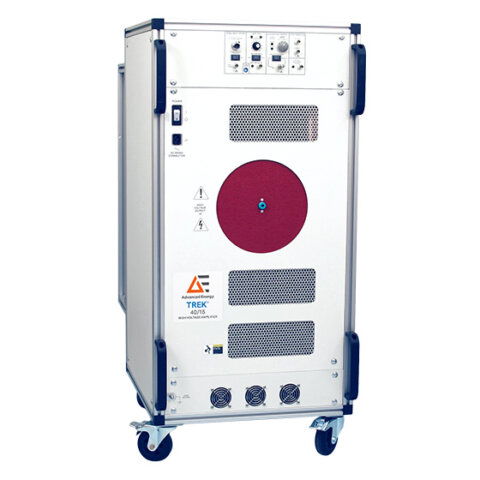
50/12-H-CE High Voltage Amplifier 50 kV, 12 mA
- Technology
- High voltage amplifiers and piezo drivers
- Partner
- Trek / Advanced Energy
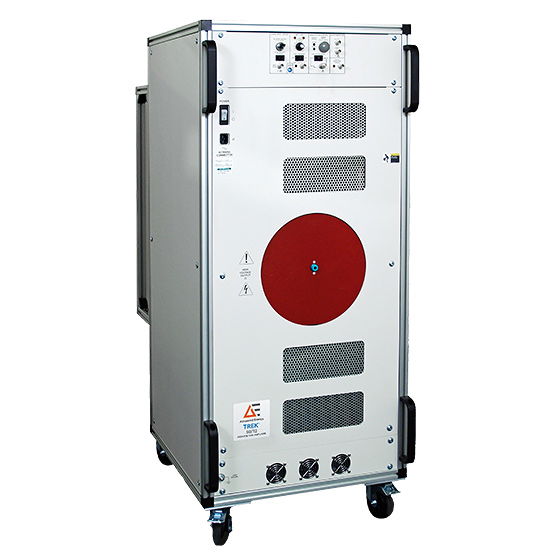
The TREK 50/12-H-CE is a high-voltage amplifier capable of delivering up to ±50 kV output at currents up to ±12 mA. It features an all-solid-state design that achieves a high slew rate of about 350 V/µs and a wide small-signal bandwidth (up to ~20 kHz) for fast and precise voltage control. The amplifier operates as a four-quadrant device, meaning it can both source and sink current; this is essential for driving reactive loads (such as capacitive or inductive elements) without performance loss. DC-stable operation allows the unit to output steady bipolar high voltages as well as dynamic waveforms, making it suitable for use as a programmable high-voltage power supply or for modulating signals. Typical applications include dielectric material testing, electrostatic deflection and beam steering, high-voltage component testing, plasma and discharge experiments, and other scientific or industrial systems requiring precise, stable high-voltage generation. The robust design integrates comprehensive protection and calibration features to ensure safe, accurate, and reliable performance in demanding high-voltage environments.
Range features
A high level overview of what this range offers
- Four-quadrant output stage – Can both source and sink current, maintaining performance with capacitive or other reactive loads (ideal for driving electrostatic devices and piezo elements).
- Closed-loop, high-accuracy design – Internal feedback ensures excellent output precision and stability across the full 0 to ±50 kV range, enhancing experimental accuracy and process control.
- Short-circuit and overload protection – Built-in current limit/trip safeguards both the amplifier and connected equipment in the event of an arc or short, improving safety and reliability.
- All solid-state construction – No moving parts or tubes, resulting in maintenance-free operation and long-term stability even under continuous use or DC bias conditions.
- DC-stable operation – Capable of holding and regulating static high-voltage outputs without drift, enabling use as a programmable DC HV supply for biasing applications.
- Low output noise – Produces a very low ripple and noise voltage (<10 V_rms), allowing ultra-accurate high-voltage outputs suitable for sensitive measurements and precision testing.
- Calibration certificate included – Each unit is delivered with a traceable calibration certificate (e.g. NIST-traceable), ensuring the output accuracy is verified to high standards from the start.
- CE compliant design – Meets international safety and EMC standards for high-voltage equipment, facilitating integration into regulated industrial and laboratory environments.
Downloads
for 50/12-H-CE High Voltage Amplifier 50 kV, 12 mA
What’s in this range?
All the variants in the range and a comparison of what they offer
| Parameter | Value |
|---|---|
Output Voltage Range | 0 to ±50 kV DC or peak AC |
Output Current Range | 0 to ±12 mA DC or peak AC |
Output Power | 600 W (max.) |
Input Voltage Range | 0 to ±10 V (for full ±50 kV output) |
Input Impedance | 25 kΩ (nominal); 50 kΩ in differential mode |
DC Voltage Gain | Fixed at 5000 V/V (50,000 V out per 10 V in) |
DC Gain Accuracy | ±0.1% of full scale (typical) |
Offset Voltage | < ±5 V |
Output Noise | < 10 V_rms (typical) |
Slew Rate (10–90% rise) |
|
Small-Signal Bandwidth (-3 dB) | DC to > 20 kHz |
Large-Signal Bandwidth (2% dist.) | DC to > 1.4 kHz |
Dimensions (H × W × D) | 1473.5 × 628.7 × 948.4 mm |
Weight | 125 – 136 kg |
AC Mains Supply | 200/230 VAC nominal (50/60 Hz) |
FAQs
for 50/12-H-CE High Voltage Amplifier 50 kV, 12 mA
This amplifier is designed to drive both resistive and reactive loads. Thanks to its four-quadrant output design, it can source or sink current as needed. In practice, that means it handles capacitive loads (like electrostatic actuators or piezo devices) and inductive loads without instability. Even if your application involves a highly capacitive sensor or an ion trap (which would normally cause a phase shift), the 50/12 unit can drive it across the full ±50 kV range while maintaining precise control and fast response.
The small-signal bandwidth (up to ~20 kHz) refers to the frequency range over which the amplifier can output small amplitude signals (typically around the -3 dB point) without significant attenuation. In other words, for small voltage swings, the output remains linear and accurate up to about 20 kHz. The large-signal bandwidth (~1.4 kHz at 2% distortion) is the range for full-scale or high-amplitude signals; at those larger voltages, the amplifier can reproduce waveforms accurately up to roughly 1.4 kHz before distortion rises (around 2% THD). Essentially, small-signal bandwidth is higher because tiny output changes are easier to reproduce at speed, whereas driving the full ±50 kV swing requires more time, limiting the upper frequency for large excursions.
The 50/12-H-CE amplifier has a fixed DC voltage gain of 5000 V/V. This means that for every 1 volt on its input, it produces 5000 volts on the output. To reach the full ±50 kV output, you need an input signal of ±10 V (5000 × 10 V = 50,000 V). The input accepts 0 to ±10 V DC or peak AC, so a standard function generator or DAC output (with ±10 V capability) can be used to drive the amplifier to its limits. The input impedance is 25 kΩ (50 kΩ in differential mode), so it won’t load typical signal sources heavily. Always ensure your input source can provide a clean ±10 V signal for full-scale output and is properly calibrated so that 10 V corresponds to the desired 50 kV at the output.
Yes. The 50/12-H-CE is DC-stable, meaning it can hold a constant high-voltage DC level indefinitely with minimal drift. You can use it as a programmable DC high-voltage power supply for biasing applications or long-duration tests. At the same time, it can output AC waveforms or transients on top of a DC bias. For example, you could apply a steady 10 kV DC bias and superimpose a small AC modulation, and the amplifier will maintain accuracy (within its bandwidth limits). The DC stability is a key feature, ensuring that even at static or slowly varying outputs, the voltage remains precise over time.
Safety and protection are integral to the 50/12-H-CE’s design. First, it offers user-selectable current limiting or automatic trip: you can set it to either clamp the output current at a defined threshold or shut down (trip) if that threshold is exceeded (for example, during an accidental short or arc). This protects both the device under test and the amplifier itself. It also has a built-in short-circuit protection, so momentary shorts at the output will not damage the unit. There are local and remote high-voltage On/Off controls, allowing integration of safety interlocks or emergency stops—essential in high-voltage setups. Additionally, the amplifier is CE compliant, meaning it meets strict safety standards (including insulation, grounding, and emissions requirements). Always follow the guidelines in the user manual for safe installation (such as proper grounding and clearance around the high-voltage output connectors).
Each amplifier is shipped with a traceable calibration certificate, verifying its performance and accuracy against national standards (for instance, NIST in the USA). This means out of the box, you can trust the voltage and current readings to be within the specified accuracy (the DC gain accuracy is better than 0.1% of full scale). To maintain accuracy over time, it’s recommended to have the unit periodically recalibrated (the interval is typically yearly or as required by your quality system). The solid-state design and internal feedback loops also help maintain calibration—drift is very low over time and with temperature, so day-to-day operation remains consistent. If needed, calibration and alignment services are available to adjust the output to nominal specifications, but under normal use the 50/12-H-CE should remain highly accurate throughout its service interval.
Such a high-voltage, precision amplifier has a range of specialised applications. In research laboratories, it’s used for studies in physics and materials science—for example, in dielectric constant measurements, high-voltage capacitor testing, or particle beam steering (where electrostatic deflection plates require controlled ±kV signals). Semiconductor and electronics industries might use it for high-voltage component testing and insulation testing, where a programmable HV source is needed to validate devices or materials. In plasma physics and gas discharge experiments, the amplifier can drive electrodes to initiate and control plasma or corona discharges (such as in dielectric barrier discharge setups). Another area is electrostatic processes: this includes electrospinning (creating nano-fibres with high voltage), electrostatic precipitation (industrial air cleaning, where charged plates remove particles), and even electrostatic levitation or spraying. Essentially, any application requiring a stable, adjustable high voltage with moderate current—especially where the load might be capacitive or require bi-directional current flow—can benefit from the 50/12-H-CE amplifier’s capabilities.