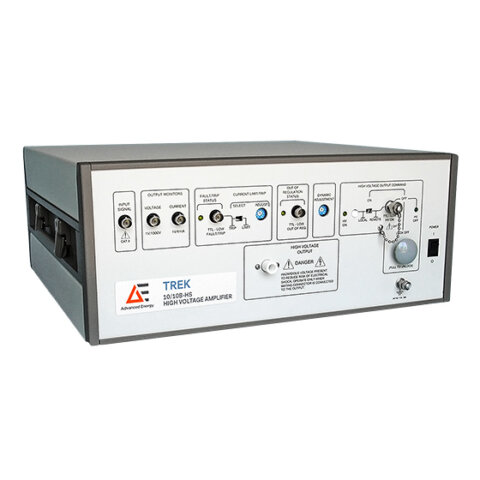
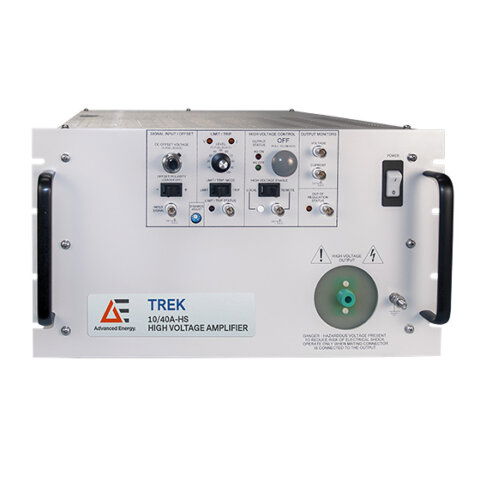
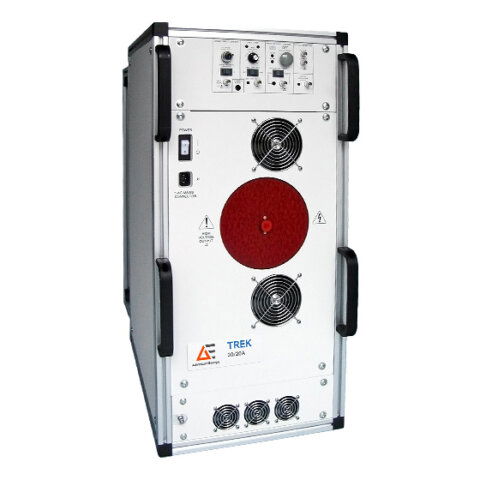
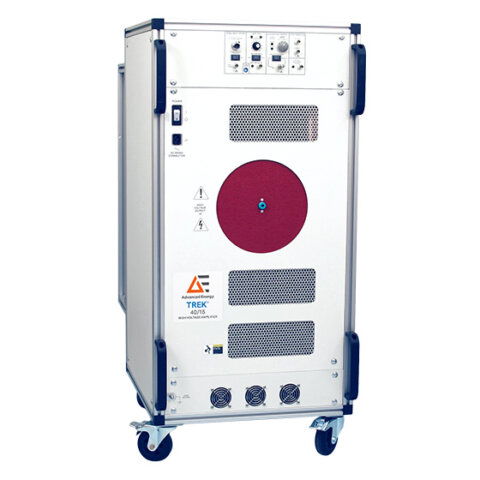
5/80-HS-H-CE High Voltage Amplifier 5 kV, 240 mA
- Technology
- High voltage amplifiers and piezo drivers
- Partner
- Trek / Advanced Energy
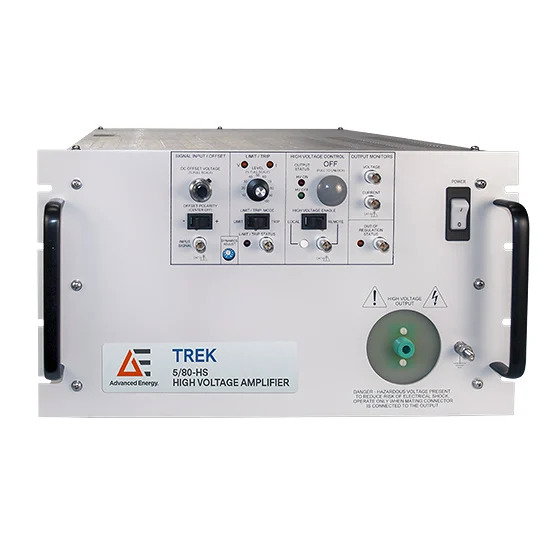
The 5/80-HS-H-CE is a high voltage power amplifier capable of outputting up to ±5 kV at up to 240 mA. It is a DC-stable, non-inverting amplifier designed for industrial and research applications that demand precise high-voltage waveforms. Engineers use this amplifier for tasks ranging from mass spectrometry and ion beam steering to driving electrostatic actuators or providing controlled AC/DC biasing in experiments. A key feature is its four-quadrant output stage, which actively sources and sinks current into reactive loads across the full output range. This design ensures an accurate and rapid response even with highly capacitive loads, enabling extremely fast voltage transitions (high slew rate). With its wide bandwidth and low noise operation, the 5/80-HS-H-CE can reliably drive dynamic high-voltage signals or maintain stable DC biases with excellent accuracy.
Range features
A high level overview of what this range offers
- Four-quadrant active output – Allows the amplifier to source or sink current into any load (capacitive or resistive), ensuring precise voltage control across the entire ±5 kV range
- Closed-loop DC-stable design – Delivers high accuracy and stability for sensitive high-voltage applications, making it suitable as a programmable power supply in research setups
- High slew rate performance – Offers rapid voltage change capability (on the order of 1000 V/µs), enabling the drive of fast transient processes and high-frequency high-voltage waveforms
- Low-noise output electronics – Provides very clean, stable high-voltage outputs with minimal ripple, resulting in highly accurate results for measurements and experiments
- All solid-state construction – Ensures maintenance-free operation and high reliability over long periods, with no reactive components needing replacement
- Short-circuit protection built-in – Safeguards the amplifier and connected devices by automatically limiting or shutting down the output in the event of an overload or direct short
- Local and remote HV control – Features both front-panel controls and a remote HV ON/OFF connector, allowing safe integration into automated systems or interlock setups for turning the high voltage on and off
- NIST-traceable calibration certificate – Each unit comes calibrated to national standards, giving engineers confidence in the output accuracy and simplifying compliance with quality requirements
- CE compliant design (230 VAC model) – The high-voltage amplifier meets European safety and EMC standards for the 230 VAC input version, ensuring it can be deployed in regulated industrial environments
Downloads
for 5/80-HS-H-CE High Voltage Amplifier 5 kV, 240 mA
What’s in this range?
All the variants in the range and a comparison of what they offer
| Specification | Value |
|---|---|
Output Voltage Range | 0 to ±5000 V DC or peak AC |
Output Current Range | 0 to ±80 mA DC (±240 mA peak AC) |
Input Voltage Range | 0 to ±5 V (for full output swing) |
Input Impedance | 10 kΩ, nominal |
DC Voltage Gain | 1000 V/V (fixed) |
Accuracy (Gain Error) | Better than 0.1% of full scale |
Offset Voltage | < ±2 V |
Output Noise | < 1.0 V RMS (typical) |
Slew Rate |
|
Large Signal Bandwidth | DC to > 60 kHz (–3 dB point at near full voltage) |
Small Signal Bandwidth | DC to > 75 kHz (–3 dB point at lower amplitude) |
Settling Time | < 50 µs (for 0 to 5 kV step to settle within 1%) |
Dimensions (H × W × D) | 279 mm × 482 mm × 654 mm (approx. 11″ × 19″ × 25.8″) |
Weight | ~24 kg (approx. 55 lb) |
Operating Temperature | 0 °C to 40 °C (32 °F to 104 °F) |
Relative Humidity | Up to 85%, non-condensing |
Altitude | Up to 2000 m above sea level |
High-Voltage Connector | Alden push-pull high-voltage output connector |
Signal Connectors | BNC (input, voltage monitor, current monitor, remote HV off, status outputs) |
FAQs
for 5/80-HS-H-CE High Voltage Amplifier 5 kV, 240 mA
Yes. The amplifier is DC-stable, meaning it can provide a constant high-voltage DC output, but it can also reproduce AC waveforms (up to its bandwidth limits) at amplitudes up to ±5 kV. You can drive it with an AC input (e.g. from a function generator) and it will output a scaled high-voltage AC signal, or you can apply a DC level for a steady high voltage. This makes it suitable for experiments requiring either static bias voltages or dynamic high-voltage waveforms.
The small-signal bandwidth (up to ~75 kHz) refers to the frequency range over which the amplifier can faithfully reproduce small amplitude sinusoidal signals (typically when the output is not at its full voltage swing, so only a fraction of the ±5 kV). The large-signal bandwidth (up to ~60 kHz) is the range it can achieve for near full-scale output swings – at those high amplitudes the frequency response is a bit lower. In practice, this means that for very large output voltages you might be limited to tens of kilohertz, while for smaller voltage perturbations the amplifier can reach slightly higher frequencies before the output amplitude starts to drop off (–3 dB point) or distortion increases.
A four-quadrant output stage means the amplifier can both source current (drive positive voltage into a load) and sink current (pull the voltage down or absorb current from the load) across both polarities of output. This capability is crucial when driving capacitive or reactive loads such as piezoelectric devices, electrostatic actuators, or other high-voltage components that can return energy to the amplifier. The 5/80-HS can actively control the voltage in both directions, ensuring the output stays accurate and stable even if the load tries to drive the voltage in the opposite direction. It prevents overshoot and allows for fast, controlled transitions, which wouldn’t be possible with a simpler one- or two-quadrant (source-only) amplifier.
This amplifier has a fixed gain of 1000 V/V. To reach the maximum ±5000 V output, you need to provide an input of ±5 V. In practice, a standard laboratory function generator or DAC with a ±5 V output range can be used to drive the 5/80-HS-H-CE directly. For example, if you input a sine wave of ±1 V amplitude, the amplifier will output a ±1000 V sine wave; inputting ±5 V will yield the full ±5000 V swing. The high input impedance (around 10 kΩ) ensures that the driving source does not need to supply significant current.
The 5/80-HS-H-CE is equipped with internal protection features. Notably, it has short-circuit and overload protection: if the output is directly shorted or if the load tries to draw more current than the specified limit (~80 mA DC or a higher peak momentarily), the amplifier will limit the output and can shut down to prevent damage. There are status indicators (and corresponding BNC outputs for remote monitoring) that alert you if the amplifier goes into a fault or out-of-regulation condition. This means the amplifier will gracefully handle fault conditions by protecting itself and the load – an essential safety feature when working with high voltages.
It is very accurate and stable for a high-voltage source. The DC gain accuracy is specified better than 0.1% of full scale, which at 5 kV means at most around ±5 V of gain error in the absolute worst case. In practice the output tracks the input very linearly. The amplifier also has a low output noise (on the order of 1 V RMS or less on a 5000 V signal), which is a tiny fraction (0.02%) of the full scale. This low noise floor and high stability make it suitable for precision tasks like calibrations, material characterisation, or sensitive beam steering, where you need a reliable high-voltage output without drift or significant ripple. Additionally, each unit is delivered with a NIST-traceable calibration certificate, so you know the output has been verified against national standards.
Yes. The amplifier provides a remote high-voltage on/off control via a BNC connector on the rear panel. By using this remote interlock capability, you can integrate the 5/80-HS-H-CE into a larger system or safety setup. For instance, you might wire that input to a safety interlock switch or a lab PLC: when the control signal is set to disable, the amplifier’s high-voltage output is turned off (or kept off) irrespective of the front-panel setting. This is valuable for ensuring the high voltage can be quickly shut down from an emergency stop or computer control, adding an extra layer of safety. In addition, the front panel has an HV on/off key switch or button (depending on model) so that an operator can manually control high voltage output enabling.
The 5/80-HS-H-CE is designed to drive a wide variety of loads, both resistive and reactive. It can drive purely resistive loads (like high-value resistors or bias networks) up to 5 kV, as well as highly capacitive or dynamic loads (like large piezoelectric actuators, electrostatic chucks, or dielectric barrier discharges). Thanks to its four-quadrant design and fast slew capability, it handles capacitive loads exceptionally well, meaning even if the load has significant capacitance (which would usually cause a phase lag or the load to pump current back), the amplifier remains stable and responsive. Inductive loads are less common at high voltage, but small inductances (like long cable leads or coils) are also manageable. In summary, as long as the load requirements are within ±5 kV and the current stays within ±80 mA DC / ±240 mA peak, the amplifier will drive it effectively while maintaining the programmed waveform.
The 5/80-HS-H-CE amplifier uses an all solid-state design, so it doesn’t have consumable parts like vacuum tubes or oil-filled components that would need regular replacement – it is essentially maintenance-free under normal operation. The cooling is typically via internal fans and heat sinks, so ensuring the ventilation slots remain unobstructed and occasionally cleaning any dust from filters (if present) is recommended for longevity. Regarding calibration: the unit comes calibrated, and for the highest precision it’s wise to recalibrate it on a recommended interval (for example, annually or biennially) to maintain traceability and accuracy. Calibration would typically be done by the manufacturer or an authorised lab with high-voltage measurement standards. Other than that, day-to-day use doesn’t require special maintenance, and the amplifier should provide consistent performance over many years of operation.