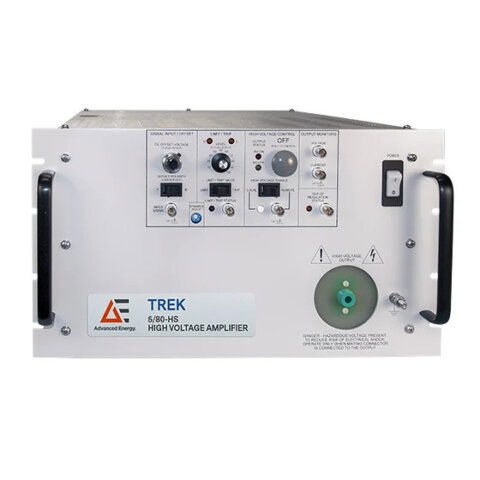
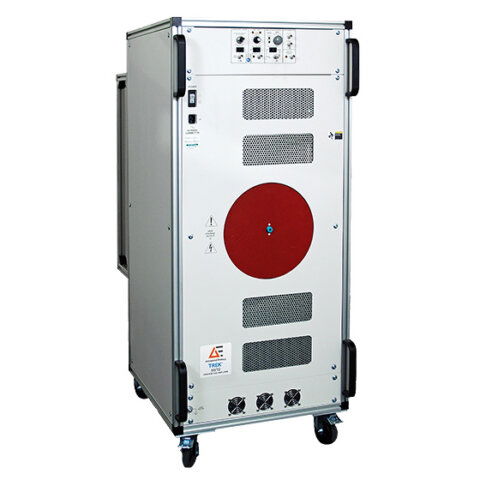
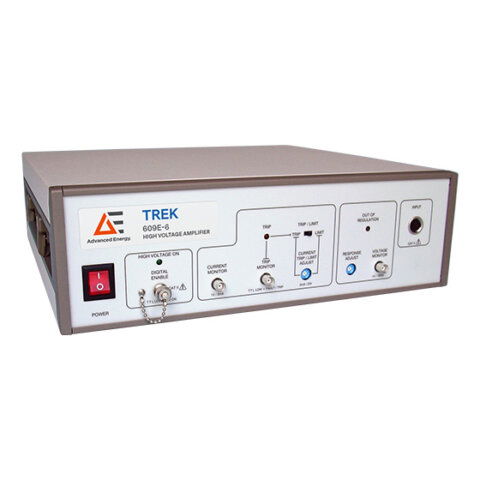
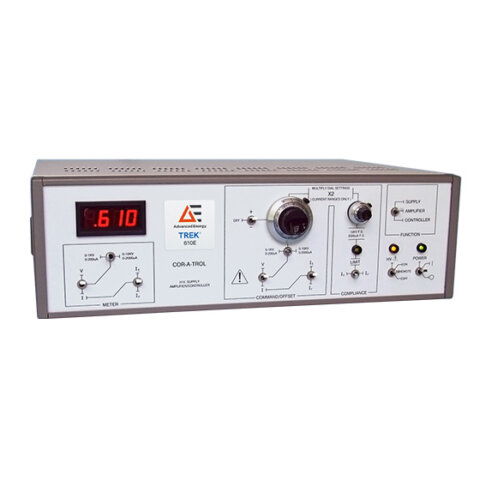
40/15-H-CE High Voltage Amplifier 40 kV, 15 mA
- Technology
- High voltage amplifiers and piezo drivers
- Partner
- Trek / Advanced Energy
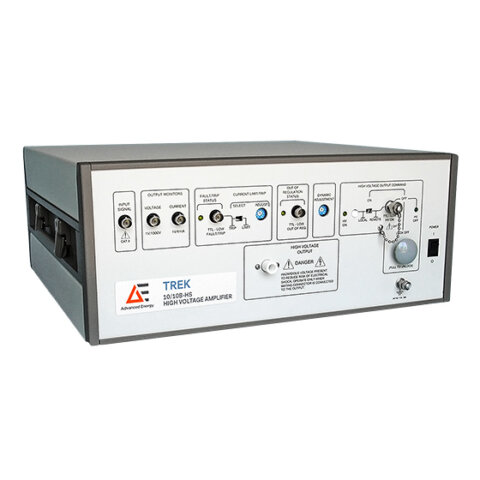
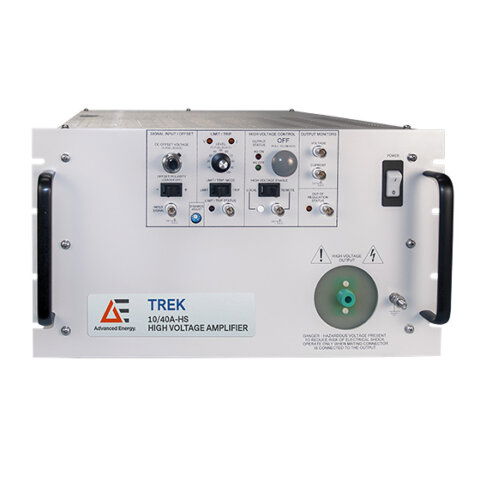
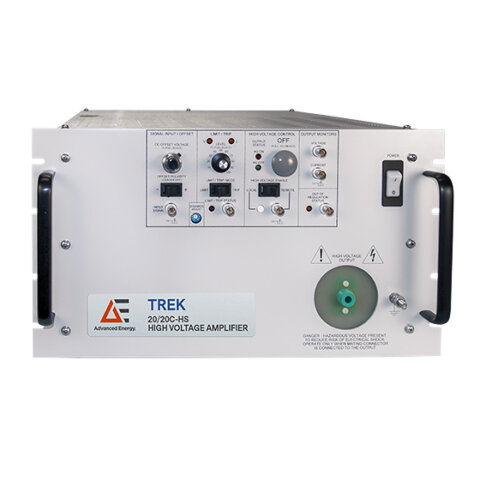
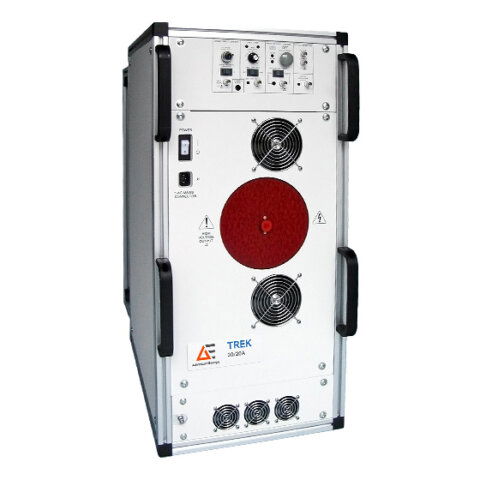
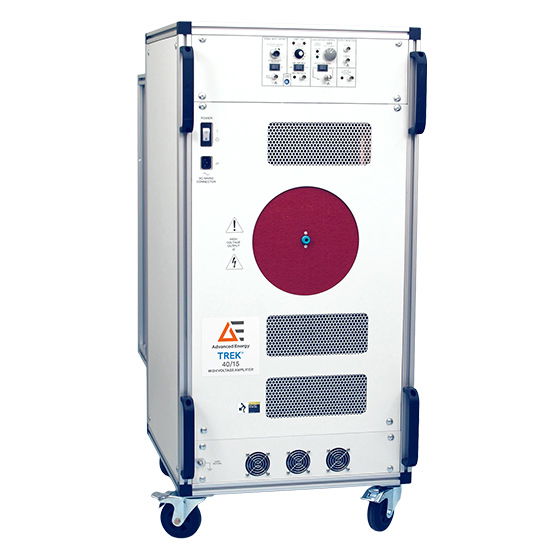
The TREK 40/15-H-CE High Voltage Amplifier is a non-inverting power amplifier capable of delivering up to ±40 kV DC or peak AC output at up to ±15 mA. It offers DC-stable, precise high-voltage output with a fixed gain of 4000 V/V, making it suitable for both steady-state biasing and dynamic high-voltage applications. Designed for demanding industrial and research settings, it drives capacitive and resistive loads with high accuracy and low noise. Typical use cases include electrostatic deflection (such as ion beam steering), electrostatic levitation, plasma and dielectric testing, and other applications requiring fast slew rates and wide bandwidth at high voltage. With robust built-in protection and remote control capabilities, this amplifier provides reliable and safe operation in environments where precise control of high voltage is essential.
Range features
A high level overview of what this range offers
- Four-quadrant output stage – Can both source and sink current, enabling the amplifier to drive highly capacitive or reactive loads without performance loss.
- All-solid-state design – Ensures virtually maintenance-free operation and long-term stability, as there are no tubes or moving parts that wear out.
- Closed-loop feedback control – Maintains high accuracy of the output voltage, so your experiments and processes benefit from precise and stable voltage levels.
- Adjustable AC response tuning – A graduated one-turn potentiometer allows you to optimise the amplifier’s AC performance for different load conditions, resulting in improved transient response across various applications.
- Overcurrent and short-circuit protection – In-built safety features automatically limit or shut down the output in fault conditions, safeguarding both the amplifier and your connected equipment.
- Local and remote HV enable – High-voltage output can be turned on or off either directly on the unit or via remote control, providing flexibility for integration into automated systems and enhancing user safety.
- Low output noise – Delivers a very clean high-voltage output with minimal ripple or fluctuations, which is crucial for sensitive applications that demand ultra-stable and accurate voltage signals.
- NIST-traceable calibration certificate – Each unit comes calibrated against NIST standards, giving confidence in measurement accuracy and compliance with quality requirements out of the box.
Downloads
for 40/15-H-CE High Voltage Amplifier 40 kV, 15 mA
What’s in this range?
All the variants in the range and a comparison of what they offer
| Specification | Value |
|---|---|
Output Voltage Range | 0 to ±40 kV DC or peak AC |
Output Current Range | 0 to ±15 mA DC or peak AC |
Output Power | 600 W (maximum) |
Slew Rate (10–90%, typical) |
|
Small-Signal Bandwidth (-3 dB) | DC to >20 kHz |
Large-Signal Bandwidth (2% dist.) | DC to >1.4 kHz |
DC Voltage Gain (fixed) | 4000 V/V |
DC Gain Accuracy | Better than 0.1% of full scale |
Input Voltage Range | 0 to ±10 V (for full output) |
Input Impedance | 25 kΩ (nominal); 50 kΩ (differential mode) |
Offset Voltage | < ±4 V |
Output Noise | < 5 V RMS (typical) |
Output Monitor Scaling | Voltage monitor and 0.5 V/mA current monitor for feedback |
Dimensions (H × W × D) | 1239 × 578 × 893 mm |
Weight | ~100 kg |
Line/Mains Voltage | 200/230 VAC, 50/60 Hz |
FAQs
for 40/15-H-CE High Voltage Amplifier 40 kV, 15 mA
A four-quadrant output stage can both source and sink current, both in positive and negative output voltage ranges. This means the 40/15-H-CE amplifier can actively drive charge into a load or pull charge out, which is especially useful for reactive loads like capacitors or piezo devices. In practice, the amplifier maintains control over the output whether the load is sourcing current back or demanding current, ensuring stable operation across all quadrants of the voltage/current plane.
“Small-signal bandwidth” (DC to >20 kHz) refers to the frequency range over which the amplifier can accurately reproduce smaller amplitude signals (typically around the linear region, measured at the -3 dB gain point). In contrast, the “large-signal bandwidth” (up to ~1.4 kHz for this model) is the frequency range over which the amplifier can drive very high amplitude signals (close to its full 40 kV output) without exceeding about 2% distortion. The difference matters because if you need to drive a full ±40 kV sine wave, the highest frequency you can achieve with low distortion is roughly 1.4 kHz. For small perturbations or lower amplitude signals, the amplifier can respond up to tens of kHz. This allows you to tailor your usage depending on whether you need maximum amplitude or a faster waveform.
The amplifier provides low-voltage monitor outputs for both the high-voltage output and the load current. These are accessible via BNC connectors on the unit. For example, the voltage monitor gives a scaled-down representation of the high-voltage output (so you can measure it with a standard oscilloscope or DVM), and the current monitor outputs a voltage proportional to the load current (with a 0.5 V per mA scale). Using these monitors, you can observe and log the actual output in real time without exposing instruments or operators to the high voltages directly.
Yes. The amplifier is well-suited for capacitive loads – in fact, it’s designed with such use cases in mind. Its four-quadrant design means it can charge and discharge capacitive loads quickly, sourcing current to increase the voltage and sinking current to decrease the voltage. The high slew rate (>350 V/µs) ensures that even large capacitive loads can be driven with fast voltage transitions. There is also an AC response tuning potentiometer that lets you optimise stability and response when driving particularly challenging loads (like large capacitances), so you can achieve the desired waveform without overshoot or oscillation.
Safety is paramount when dealing with high voltages. The 40/15-H-CE amplifier includes several protective features: an automatic current limit and trip that will activate if the output current exceeds 15 mA (to prevent damage or unexpected output conditions), and a built-in short-circuit protection that immediately safeguards the output stage if the high-voltage output is accidentally shorted to ground. Additionally, the unit has an interlock and HV enable control – you must actively enable the high-voltage output (either via a switch or remote control signal) for it to turn on, reducing the risk of accidental energisation. The high-voltage output connector is a special fully insulated type for safe connection. The system also comes with a calibrated metering and status indicators (for voltage, current, and limit/trip status) on the front panel so you can continuously monitor operation. As always, proper grounding and following the user manual guidelines are critical for safe operation at these voltage levels.
This amplifier is analogue-controlled with a standard low-voltage input. To set the high-voltage output, you supply a control voltage (for the 40/15-H-CE, an input of ±10 V yields the full ±40 kV at the output, given the fixed 4000 V/V gain). This control input is usually provided by a function generator, DAC output, or other analogue signal source. There isn’t a built-in arbitrary waveform generator, so you provide whatever waveform or DC level you need, and the amplifier will faithfully scale it up to the high voltage domain. In addition to the analogue input, you have remote on/off capability and status outputs that can be integrated into a control system if needed. There’s no direct digital interface for waveform control, which actually helps keep the response fast and deterministic – you’re essentially limited only by the bandwidth and slew capabilities of the analogue circuitry.
Because it’s an all-solid-state design, routine maintenance is minimal – there are no consumable parts like tubes to replace. The main things are to ensure it’s kept in a clean, cool environment so that the cooling vents and fans (if any) can operate effectively, given the unit will dissipate heat (it’s a 600 W output device at full power). Regarding calibration, it is shipped with a NIST-traceable calibration, and it’s good practice to have it recalibrated on a recommended interval (for example, annually or biennially) to ensure continued accuracy of the voltage and current readouts and monitors. Calibration typically needs to be done by the manufacturer or an authorised lab due to the high-voltage precision involved. Other than that, you should periodically check the high-voltage output connector and cable for any signs of wear or degradation (since those see the stress of 40 kV) and replace them if needed. By following the guidelines in the user manual for operation and storage, the unit should provide stable performance for many years.