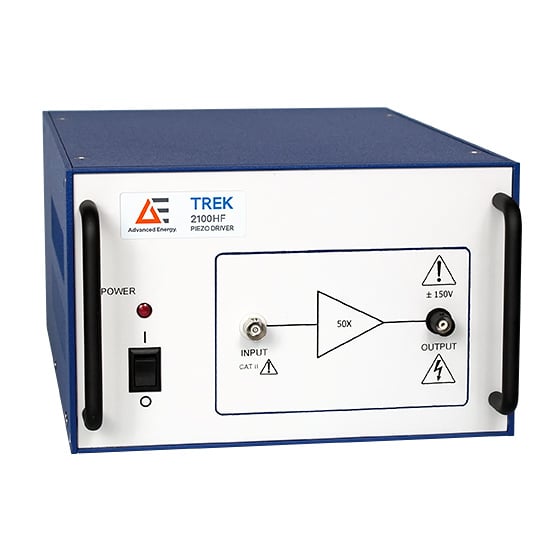
2100HF-H-CE High Frequency Amplifier ±150 V @ ± 300 mA
- Technology
- High voltage amplifiers and piezo drivers
- Partner
- Trek / Advanced Energy
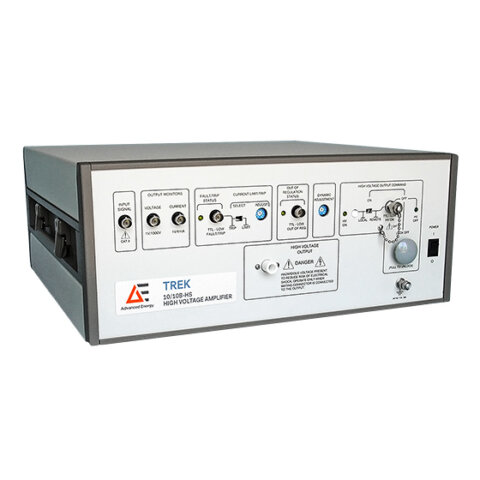
The TREK 2100HF-H-CE is a high-frequency, high-voltage amplifier designed for precision applications that demand fast and accurate voltage amplification. It delivers up to ±150 V output at up to ±300 mA, making it suitable for driving capacitive loads and piezoelectric actuators with ease. This amplifier provides a stable, wide bandwidth performance – it remains essentially flat in frequency response up to the MHz range – allowing users to apply high-voltage signals at frequencies up to the low MHz without significant distortion. With a robust all-solid-state design and dual-feedback control, it operates reliably with low noise and without overshoot, ensuring sensitive experiments or industrial processes can be conducted with confidence. Typical use cases include dielectric material testing, electro-optic modulation, ion beam control, MEMS device actuation, piezoelectric element driving, and ultrasonic transducer excitation, among others, where a combination of high voltage and high speed is required.
Range features
A high level overview of what this range offers
- Wide output range – Versatile for various loads: Provides 0 to ±150 V output and up to ±300 mA current, allowing it to drive both high-voltage and moderate-current devices (useful for capacitive sensors, actuators, or piezo elements).
- High slew rate – Fast signal transitions: Achieves a slew rate of at least 2000 V/µs, enabling it to reproduce rapid voltage changes and high-frequency waveforms accurately without delay or distortion.
- Broad bandwidth – Supports high-frequency operation: Maintains a wide bandwidth (full-power bandwidth >2 MHz), meaning even at maximum voltage it can output signals in the low MHz range; small-signal bandwidth exceeds 3 MHz for even higher frequency response when output amplitude is reduced.
- Dual-feedback design – Stable and no overshoot: Uses a unique dual feedback loop to control the output, which effectively prevents waveform overshoot and instability. This ensures the output voltage closely follows the input command without ringing, crucial for precision testing and reliable device operation.
- Low-noise solid-state output – Clean signal for sensitive applications: The amplifier’s all-solid-state architecture and low-noise design minimise output ripple and electromagnetic interference. This provides a clean high-voltage signal, beneficial for experiments in physics or engineering where signal integrity is important.
- Calibration included – Measurement confidence: Each unit comes with a NIST-traceable calibration certificate. Users can trust the accuracy of the output voltage and gain, and integrate the amplifier into measurement setups knowing it meets stated specifications.
- Reliable build – Continuous operation in demanding settings: Engineered for high reliability, it can operate continuously at up to 45 W output power. Its design supports consistent performance in industrial or lab environments, reducing downtime and maintenance needs for high-voltage testing systems.
- Designed for capacitive loads – Ideal for piezo and electrostatic devices: Specifically capable of driving highly capacitive loads (like piezoelectric actuators or electrostatic devices) at high speed. The output stays stable even when charging and discharging capacitors rapidly, which is essential for accurate control in applications like precision motion or beam steering.
- Flexible usage – DC and AC amplification: Capable of amplifying DC signals up to high-frequency AC. This means it can supply a steady high-voltage bias or rapidly oscillating voltage as required, making it useful for both static field applications and dynamic signal applications.
- Safety and compliance – Ready for integration: The 2100HF series is built with safety features and complies with RoHS. Its output connectors and chassis are designed with high-voltage safety in mind, allowing integration into equipment racks or setups with proper grounding and user protection.
Downloads
for 2100HF-H-CE High Frequency Amplifier ±150 V @ ± 300 mA
What’s in this range?
All the variants in the range and a comparison of what they offer
| Parameter | Value |
|---|---|
Output Voltage Range (DC or AC peak) | 0 to ±150 V |
Output Current Range | 0 to ±300 mA |
Maximum Output Power | 45 W (approximately) |
Fixed Gain | 50 V/V (non-inverting) |
Input Voltage (for full output) | ±3 V (for ±150 V output) |
Slew Rate (rated) | ≥ 2000 V/µs (min.) |
Large-Signal Bandwidth (−3 dB) | DC to > 2.6 MHz |
Small-Signal Bandwidth (−3 dB) | DC to > 3 MHz |
Full-Power Bandwidth (flat response) | ~2 MHz (up to −0.1 dB) |
Output Noise | Low (all-solid-state design, not stated in datasheet) |
Output Stability | No overshoot (dual feedback control) |
Calibration | NIST-traceable certificate provided |
Compliance | RoHS compliant, CE marked (Model -CE) |
Operating Modes | Standalone bench/rack amplifier, DC coupling |
Typical Applications | Dielectric testing, piezo actuation, electro-optic modulation, ion beam control, ultrasonics, MEMS, etc. |
Note: Specifications are based on the 2100HF series datasheet. “Large-signal” refers to maximum voltage swing conditions, and “small-signal” refers to reduced amplitude conditions. Bandwidth values are typical – actual performance may exceed the stated minimums.
FAQs
for 2100HF-H-CE High Frequency Amplifier ±150 V @ ± 300 mA
The 2100HF-H-CE has a fixed gain of 50 V/V. This means you need an input of ±3 V to achieve the maximum ±150 V output swing. It is designed to be driven by standard function generators or DAC outputs – for instance, a 2 V peak sine wave in will result in a 100 V peak output. The input is typically a low-voltage analog signal (there’s no internal signal source), so you provide the waveform or bias and the amplifier boosts it by 50× at the output.
This amplifier uses two feedback loops in its internal circuitry. One feedback loop controls the overall gain and output level, while the second, faster loop corrects any rapid changes or tendencies for the output to ring. Together, they ensure that when the output voltage reaches the desired level, it does not overshoot or oscillate. Essentially, the amplifier continuously self-corrects any deviation, so the output waveform closely follows the input without spikes, even when driving reactive loads or at high slew rates.
Yes. The 2100HF series is explicitly designed for driving highly capacitive loads like piezoelectric transducers, electrostatic actuators, or dielectric testing cells. It can source and sink the rapid charge and discharge currents demanded by capacitors. With its high slew rate and stable response, it can drive a piezo actuator at high frequencies (up to the low MHz range) without instability. The amplifier remains stable and maintains waveform fidelity even if the load is purely capacitive, which is a key requirement for applications like piezo motion control or ultrasonic transducers.
This amplifier is very versatile in any scenario requiring a combination of high voltage and high frequency. Common applications include dielectric material characterization (applying AC fields to materials and measuring responses), electro-optic modulation (driving Pockels cells or similar devices in laser systems), ion beam control (deflection or focusing plates in physics experiments), microelectromechanical systems (MEMS) actuation, piezoelectric driving and control (for precision movement or ultrasound generation), and ultrasonics (driving ultrasonic transducers for imaging or cleaning). Essentially, engineers and researchers use it whenever they need to amplify signals to hundreds of volts at frequencies ranging from DC up to a few megahertz.
No – the 2100HF-H-CE is designed for low-noise operation. Its solid-state (transistor-based) output stage and careful internal filtering help keep the output voltage clean. For the user, this means the high-voltage output won’t add significant extra noise to your experiment or device under test beyond what’s inherent in high-frequency operation. Of course, at very high slew rates and bandwidths some wideband noise is inevitable, but it’s minimized. The absence of overshoot and the stable waveform also contribute to low noise in the sense of signal quality (no ringing or spurious oscillations). In sensitive applications, proper grounding and shielding of connecting leads will further ensure the output remains as noise-free as possible.
It can output DC, AC, or any waveform in between, within its voltage and current limits. The amplifier is DC-coupled, meaning if you input a DC voltage, the output will produce a DC high voltage (up to ±150 V) scaled by the gain. This is useful if you need a steady high-voltage bias in addition to dynamic signals. Conversely, for AC, it can reproduce high-frequency signals on top of a DC offset if needed. Essentially, it covers DC to the specified bandwidth, so you have flexibility to apply static voltages, dynamic waveforms, or a combination (like a high-voltage bias plus a superimposed AC signal).
Each 2100HF unit is shipped with a NIST-traceable calibration certificate, which verifies that the amplifier’s output meets the specified accuracy under defined conditions. This means the manufacturer has tested and adjusted the unit against national standards for voltage (and possibly frequency response). In practice, you can trust that the gain (50×) and output range are accurate as stated. Over time (or if the unit is used heavily), you may want to recalibrate it periodically. The certificate typically indicates the calibration date, and you can have the amplifier recalibrated at authorized service centres to maintain its precision for critical applications.