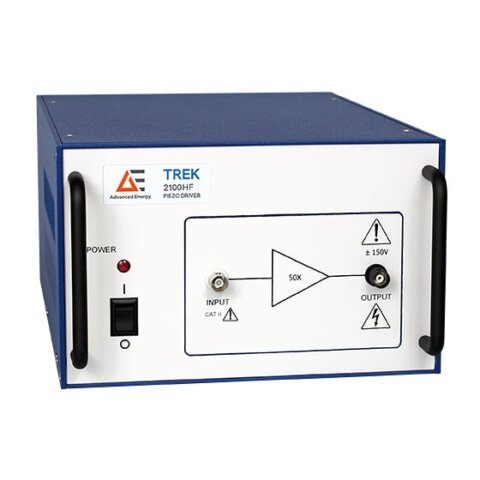
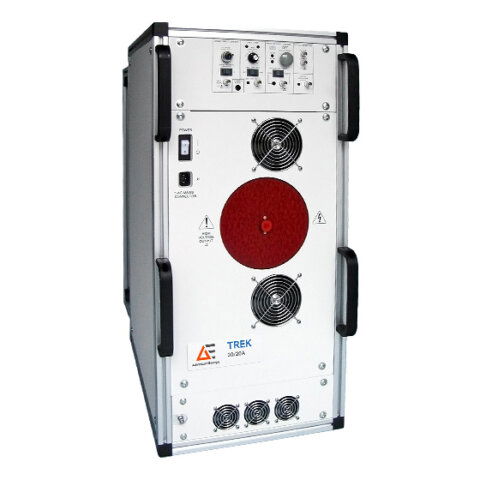
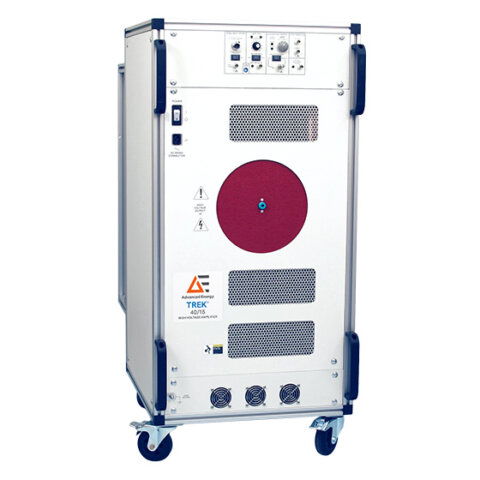
20/20C-HS-H-CE High Voltage Amplifier 20 kV, 60 mA
- Technology
- High voltage amplifiers and piezo drivers
- Partner
- Trek / Advanced Energy
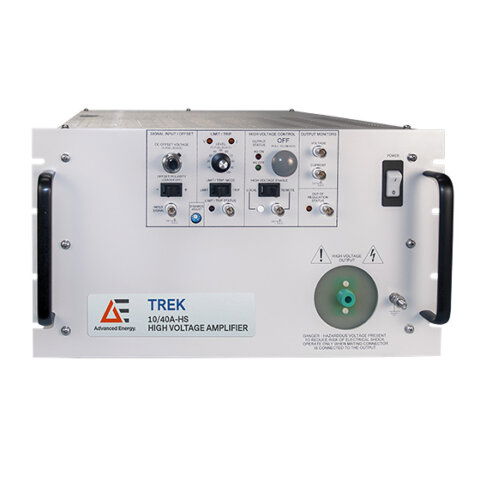
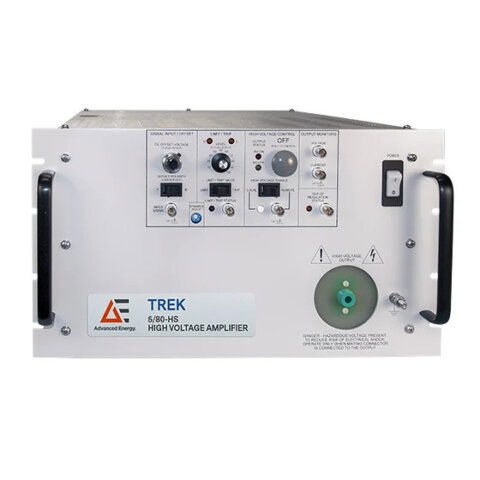
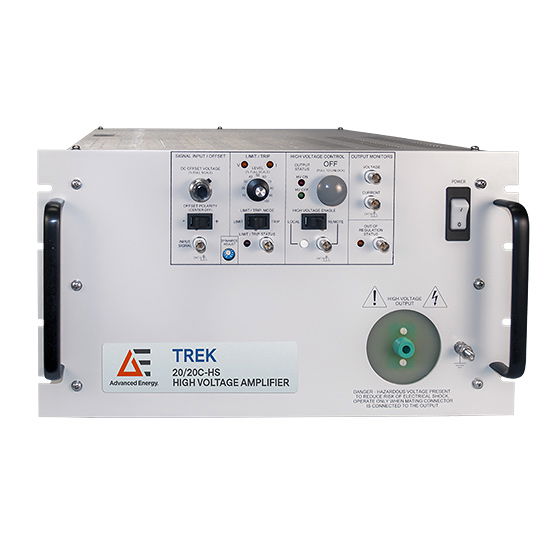
The TREK 20/20C-HS-H-CE is a high-speed, high-voltage power amplifier designed for precision applications that require up to 20 kV output at up to 60 mA of current. It features a four-quadrant output stage, which means the amplifier can both source and sink current across its full voltage range, making it well-suited to driving capacitive or reactive loads with stability and accuracy. This model is DC-stable and offers low output noise, allowing it to serve as a dependable high-voltage DC supply or to reproduce fast high-voltage waveforms with minimal distortion. Engineers use this amplifier in a wide range of industrial and research settings – from particle accelerator laboratories and plasma research facilities to high-voltage device testing, materials processing, and electrostatic applications like beam steering and dielectric breakdown experiments. The unit’s all-solid-state design ensures maintenance-free operation, and it comes with built-in safety features (including short-circuit protection and a CE-compliant 230 VAC design) for reliable integration into advanced test systems. Each amplifier is delivered fully calibrated with a traceable certificate, ensuring measurement accuracy and confidence in performance from the outset.
Range features
A high level overview of what this range offers
- Four-quadrant output – Can source and sink current, ensuring stable performance even with capacitive or reactive loads (ideal for piezo actuators, electrostatic devices, etc.)
- High slew rate (~800 V/µs) – Enables rapid voltage transitions for high-speed waveform fidelity and fast response in pulsed or AC high-voltage applications
- Wide bandwidth – Amplifies signals from DC up to 5.2 kHz at full output (and over 20 kHz for small-signal swings), supporting dynamic high-voltage waveforms with low distortion
- Low output noise – Provides ultra-stable and clean high-voltage output, which enhances precision in sensitive measurement and biasing applications
- Short-circuit protection – Safeguards both the amplifier and the load by limiting current and shutting down output in the event of overload or direct short conditions
- DC-stable, closed-loop design – Maintains accurate output with minimal drift, allowing use as a programmable high-voltage DC supply for long-duration experiments or biasing tasks
- Solid-state reliability – All-solid-state architecture offers virtually maintenance-free operation and long-term stability without the need for routine component replacements
- Remote and local control – Provides a front-panel high-voltage ON/OFF switch and a remote TTL control input, giving flexibility for integration into automated test setups and safety interlocks
Downloads
for 20/20C-HS-H-CE High Voltage Amplifier 20 kV, 60 mA
What’s in this range?
All the variants in the range and a comparison of what they offer
| Specification | Value |
|---|---|
Output voltage range | 0 to ±20 kV DC or peak AC |
Output current range | 0 to ±20 mA DC (continuous); ±60 mA peak (≤ 1 ms) |
Slew rate (10–90% rise) |
|
Small-signal bandwidth (-3 dB) | DC to > 20 kHz |
Large-signal bandwidth (1% THD) | DC to > 5.2 kHz |
Output power | 400 W (maximum) |
DC voltage gain | 2000 V/V (fixed) |
Gain accuracy | ±0.1% of full scale |
Input voltage (for full output) | 0 to ±10 V (DC or peak AC) |
Input impedance | 25 kΩ (nominal) |
Offset voltage | < ±2 V (DC offset at output, after zeroing) |
Output noise | < 1.5 V_rms (over full range, typical) |
Output stage type | Four-quadrant active bipolar output stage |
Protection features | Automatic current limit/trip, short-circuit protected |
Voltage monitor output | Scaled 1/2000 of output voltage (±0.1% accuracy, BNC) |
Current monitor output | 1 V per 6 mA of output (±1% accuracy, BNC) |
HV enable control | Local push-button and remote TTL (active low) |
AC supply (line input) | 180–250 VAC or 104–127 VAC, 48–63 Hz (factory set) |
Certification | CE compliant (230 VAC model variant) |
Dimensions (H × W × D) | 279 mm × 482 mm × 654 mm (11" × 19" × 25.75") |
Weight | ~24.9 kg (approx. 55 lb) |
Operating temp. range | 0 °C to 40 °C ambient |
Humidity & altitude | Up to 85% RH (non-condensing); max. 2000 m altitude |
FAQs
for 20/20C-HS-H-CE High Voltage Amplifier 20 kV, 60 mA
A four-quadrant output stage means the amplifier can both source and sink current and can drive both positive and negative voltages into the load. In practical terms, this design allows the ±20 kV amplifier to handle capacitive or inductive loads without instability. It will actively pull the output toward 0 when needed, enabling precise bipolar control of high-voltage signals even with reactive loads (for example, rapidly charging and discharging a capacitor).
The small-signal bandwidth refers to the frequency range over which the amplifier can faithfully reproduce smaller amplitude signals (within its linear range) – in this case from DC up to about 20 kHz (-3 dB point). The large-signal bandwidth is defined for full-scale output swings, and is lower (DC to around 5.2 kHz for a near 20 kV peak-to-peak output with ~1% distortion). In simpler terms, the amplifier can handle very fast, minor voltage changes up to tens of kilohertz, but for maximum 20 kV excursions, the practical frequency limit is on the order of a few kilohertz due to slew rate and power constraints.
This amplifier is used in a broad array of scientific and industrial applications. Typical uses include driving electrostatic deflection plates in particle accelerators, providing bias voltage in plasma generation and dielectric barrier discharge experiments, and controlling high-voltage waveforms in material science (e.g. ferroelectric material poling or insulation breakdown testing). It’s also well-suited for electro-optic modulation, electrospinning setups, ion beam steering, and any application requiring a stable, programmable high-voltage source with fast response. Essentially, any scenario that needs up to ±20 kV with fine control and fast switching could benefit from the 20/20C-HS amplifier.
The amplifier is controlled by a low-voltage input signal: an analog voltage of ±10 V will drive the output through the full ±20 kV range (the fixed gain is 2000 V/V). You can input this control voltage via a front-panel BNC connector from a function generator or DAC. The unit also provides convenient monitoring outputs – one BNC gives a low-voltage representation of the high-voltage output (at a scale of 1/2000, so 10 V corresponds to 20 kV), and another BNC provides a current monitor (1 V output per 6 mA of load current). These monitors allow you to observe the actual output voltage and current on an oscilloscope or measurement device in real time, for safe and accurate feedback without measuring the high voltage directly.
The 20/20C-HS-H-CE is equipped with comprehensive protection features. It has an adjustable current limit/trip circuit: if the load tries to draw more than the set current threshold (for example, due to a short-circuit or an arc discharge), the amplifier will either limit the output current or shut down (trip) to prevent damage. The output is also inherently short-circuit protected, meaning momentary shorts to ground won’t destroy the unit. Additionally, the amplifier will go into an out-of-regulation or fault state if it cannot sustain the commanded output (e.g., if pushed beyond its bandwidth or power capabilities), and it will disable the high-voltage output until the condition is resolved. There are status indicators for such fault or trip conditions on the front panel, and the design includes safety interlocks (the high-voltage output is automatically disabled if a cover panel is removed, for instance). All these features ensure safe operation and protect both the user and the equipment connected to the amplifier.
Yes. The amplifier is DC-stable, meaning it can hold a constant high-voltage output without drifting, just like a regulated high-voltage power supply. You can dial in a DC level (by applying a constant control voltage) and the amplifier will output a matching DC voltage up to 20 kV with high accuracy. Thanks to its closed-loop design, the output will remain steady (drift is very low, on the order of tens of ppm per hour after warm-up). This makes it suitable for biasing components or materials with a high DC voltage over long durations. Do note that the continuous output current is limited to 20 mA, so within that current capability it behaves like a programmable HV supply. The unit even comes with a calibration certificate, so you can trust that the output voltage corresponds precisely to your setting (within the specified accuracy).
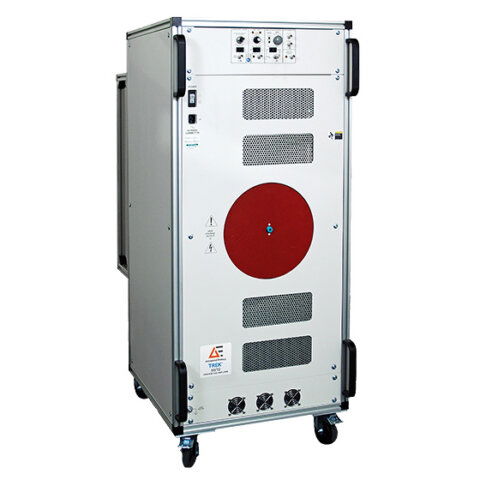
The 20/20C-HS-H-CE is designed in a standard 19-inch rack-mount chassis (approximately 11 inches tall, which is 6U height). It will physically fit into a standard equipment rack or can be used on a lab bench. Weighing about 25 kg, it’s fairly heavy, so it may require a sliding shelf or two-person lifting for rack installation, but once in place it’s very stable. In terms of power requirements, the "-H-CE" model runs on typical mains supply (factory-set for 180–250 V AC, 50/60 Hz for CE compliance, with an alternative configuration for 115 V AC if needed). Integration-wise, control is straightforward via BNC connectors, and the front panel provides easy access to controls and status indicators. Overall, as long as you have the physical space and a suitable mains supply, the amplifier is quite plug-and-play for high-voltage work. It’s advisable to ensure proper grounding and follow the user manual’s guidelines for ventilation and safety, but no special infrastructure beyond standard lab equipment is required.