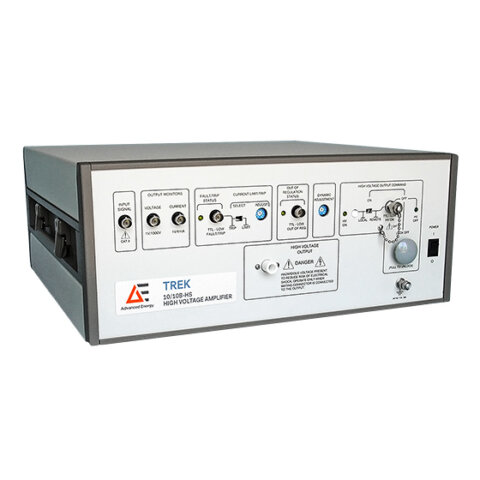
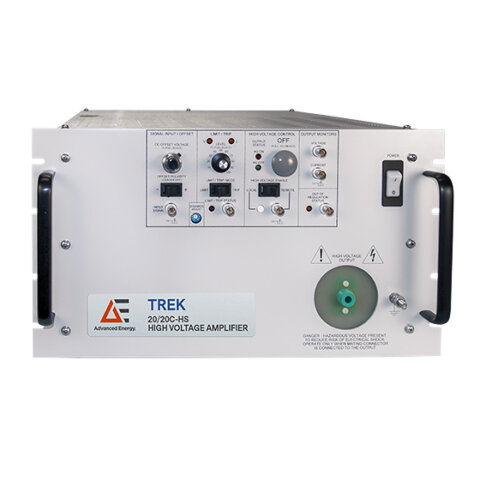
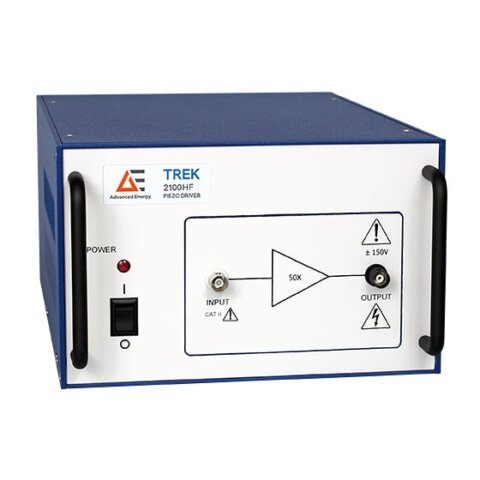
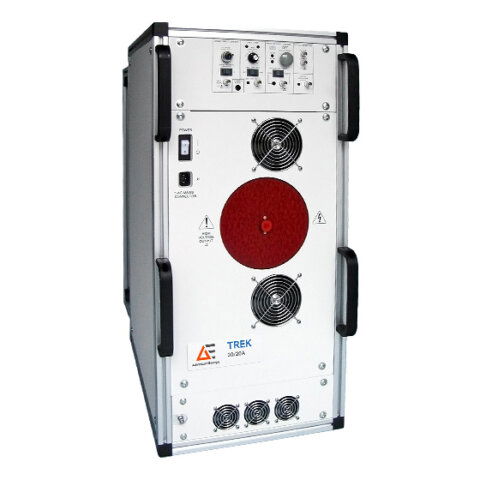
10/40A-HS-CE High Voltage Amplifier 10 kV, 120mA
- Technology
- High voltage amplifiers and piezo drivers
- Partner
- Trek / Advanced Energy
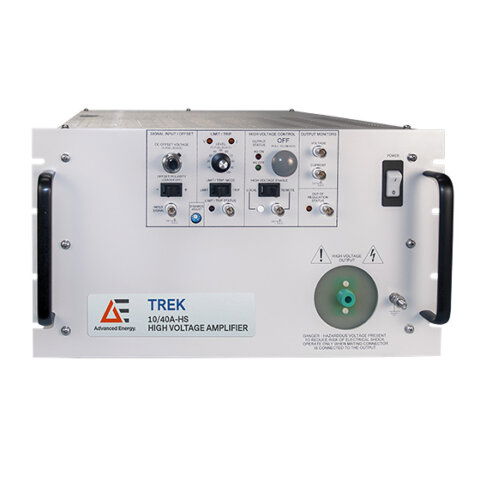
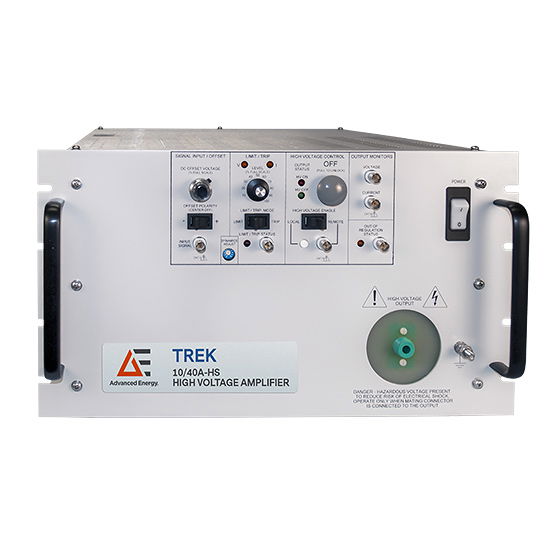
The TREK 10/40A-HS-CE is a high-speed, high voltage amplifier capable of outputting up to ±10 kV and ±120 mA for demanding applications. It features a four-quadrant output stage, meaning it can both source and sink current, which is essential for driving capacitive or reactive loads with precision. Designed for DC stability and wide bandwidth, this amplifier can reproduce high-voltage waveforms up to the tens of kilohertz range without significant distortion. Typical uses include scientific and industrial tasks such as electrophoresis, electro-optic modulation, ferroelectric material poling, and dielectric discharge experiments, among many others.
The unit’s solid-state design and closed-loop control ensure low noise and high accuracy, making it ideal for sensitive applications requiring stable, ultra-accurate high voltage outputs. With robust build quality and comprehensive protection features, the 10/40A-HS-CE provides reliable performance in laboratory, manufacturing, and research environments.
Range features
A high level overview of what this range offers
- Four-quadrant active output – Allows the amplifier to both source and sink current, enabling precise drive of capacitive and other reactive loads without performance loss.
- High slew rate & broad bandwidth – Delivers fast voltage transitions (up to ~900 V/µs) and wide frequency response, supporting accurate reproduction of rapid high-voltage waveforms in dynamic testing.
- Closed-loop, low-noise design – Ensures high output accuracy and stability across the full range, providing ultra-low ripple and noise for sensitive measurements.
- DC-stable and programmable – Suitable for both steady DC high-voltage biasing and AC signal amplification, with minimal drift, making it versatile for various test scenarios.
- Selectable current limit or trip – User-configurable protection lets you either cap the output current or shut down the output during overloads, safeguarding your load and the amplifier itself.
- Local and remote HV control – High-voltage output can be switched on/off from the front panel or via remote control signals, offering flexibility and an extra layer of safety in system integration.
- Short-circuit protected output – Built-in protection circuitry prevents damage in the event of an output short or arc, ensuring safe recovery and continued operation.
- NIST-traceable calibration – Each unit includes a calibration certificate traceable to NIST standards, guaranteeing that the output accuracy is verified and instilling confidence in measurement precision.
- CE compliant design – The 230 VAC version of the unit meets CE safety and EMC requirements, underscoring its adherence to international safety standards and suitability for use in regulated environments.
Downloads
for 10/40A-HS-CE High Voltage Amplifier 10 kV, 120mA
What’s in this range?
All the variants in the range and a comparison of what they offer
| Specification | Value |
|---|---|
Output Voltage Range | 0 to ±10 kV DC or peak AC |
Output Current Range | 0 to ±40 mA DC (≤ 40 mA rms); ±120 mA peak (1 ms) |
Output Power | 400 W |
Input Voltage Range | 0 to ±10 V (analogue control input for full output) |
Input Impedance | 25 kΩ (nominal) |
DC Voltage Gain | 1000 V/V |
DC Gain Accuracy | ≤ ±0.1% of full scale |
Offset Voltage | < ±2 V |
Output Noise | < 0.5 V RMS (over full output range) |
Slew Rate (10%–90% rise) |
|
Small-Signal Bandwidth (-3 dB) | DC to > 25 kHz |
Large-Signal Bandwidth (-3 dB) | DC to > 23 kHz |
Large-Signal Bandwidth (1% THD) | DC to > 9 kHz (typical) |
Dimensions (H × W × D) | 279 mm × 482 mm × 654 mm (11" × 19" × 25.75") |
Weight | 24.9 kg (55 lbs) |
FAQs
for 10/40A-HS-CE High Voltage Amplifier 10 kV, 120mA
“Four-quadrant output” refers to the amplifier’s ability to both source and sink current, both in positive and negative voltage polarities. In practice, this means the 10/40A-HS-CE can drive a load that returns energy (such as a capacitive or inductive load) just as effectively as it drives a load that purely consumes energy. This capability ensures stable and accurate output even when the load’s impedance changes or feeds back current into the amplifier.
Yes. This amplifier is designed specifically to handle capacitive and other reactive loads. Its high slew rate (~900 V/µs) and four-quadrant output stage allow it to charge and discharge capacitive loads quickly without oscillation. The closed-loop feedback and current sourcing/sinking ability mean it will maintain control over the output voltage even when driving demanding capacitive elements (such as piezoelectrics or large electrostatic plates).
The 10/40A-HS-CE is used in a variety of high-voltage applications in both research and industry. Typical uses include electrophoresis (driving high voltages through gels or fluids for molecular separation), electro-optic modulation (controlling Pockels cells and other optical modulators), material poling (aligning dipoles in ferroelectric or piezoelectric materials), and dielectric breakdown testing. It’s also suitable for general high-voltage AC or DC biasing in laboratories, ion beam steering, mass spectrometry, and anywhere precise, fast-switching high voltage is required.
The 10/40A-HS-CE is controlled via an analogue low-voltage input. By applying a ±10 V input signal (for example, from a function generator or DAC), you can drive the output across its full ±10 kV range (the amplifier has a fixed gain of 1000 V/V). The front panel includes a high-voltage ON/OFF switch (and can be controlled remotely as well) for safety. There are also BNC monitor outputs: one provides a low-voltage representation of the high-voltage output (for example, 1 V out corresponds to 1000 V output, allowing you to observe the output waveform on an oscilloscope), and another monitor provides a proportional voltage representing the output current. These features make it straightforward to control and measure the amplifier’s output in real time.
This amplifier includes multiple layers of protection to ensure safe operation. It has a user-selectable current limit/trip setting: in current limit mode, the amplifier will cap the output current to a preset threshold (preventing it from exceeding ~40 mA DC or the set limit), whereas in trip mode the amplifier will shut down (disable output) if an over-current condition occurs. The output is also short-circuit protected, meaning if the output is accidentally shorted or if an arc discharge happens, the amplifier can tolerate it momentarily without damage and will either limit or trip off as configured. Additionally, an internal interlock and remote control capability can be used as safety measures (for example, a laboratory safety interlock can be wired to the remote HV off). The amplifier also only enables high-voltage output when the front panel toggle is on (and remote interlock closed), providing a fail-safe against unintended HV activation. Finally, the unit is CE compliant (on 230 V models), which means it meets strict safety and electromagnetic compatibility standards.
Small-signal bandwidth refers to the frequency range over which the amplifier can output small amplitude signals (generally a few percent of full scale) with minimal attenuation (typically -3 dB point). For the 10/40A-HS-CE, the small-signal bandwidth extends beyond 25 kHz, meaning it can reproduce small amplitude high-voltage oscillations up into the tens of kilohertz. Large-signal bandwidth refers to the bandwidth when the amplifier is driving large amplitude signals (near full ±10 kV swing). In this amplifier, the large-signal -3 dB bandwidth is around 23 kHz. The difference arises mainly due to the slew rate and power limitations: at very high frequencies, a full ±10 kV sine wave is harder to drive, so the effective bandwidth for large swings is a bit lower. In practical terms, this means the amplifier can drive smaller AC signals at slightly higher frequencies, while the maximum amplitude signals are limited to roughly the low 20 kHz range. Additionally, the amplifier’s 1% distortion large-signal bandwidth is ~9 kHz, indicating that if you need very low-distortion output, staying below ~9 kHz for full-scale signals is advisable.
The 10/40A-HS-CE includes built-in monitor outputs that make it easy to observe the output in real time. On the front panel (or rear panel, depending on the model), there are BNC connectors for a Voltage Monitor and a Current Monitor. The voltage monitor provides a scaled-down replica of the high-voltage output (for example, 0–10 V corresponding to 0–10 kV), which you can connect to an oscilloscope or datalogger to see the actual output waveform and voltage level without needing a high-voltage probe. Similarly, the current monitor outputs a low-voltage signal proportional to the output current (allowing you to track how much current is being sourced or sunk into your load). Using these monitors, you can safely measure and record the amplifier’s performance (voltage and current) during experiments. The instrument’s included calibration ensures that these monitor outputs are accurate representations of the actual values.