10/10B-HS-H-CE High Voltage Amplifier 10 kV, 40 mA
- Technology
- High voltage amplifiers and piezo drivers
- Partner
- Trek / Advanced Energy
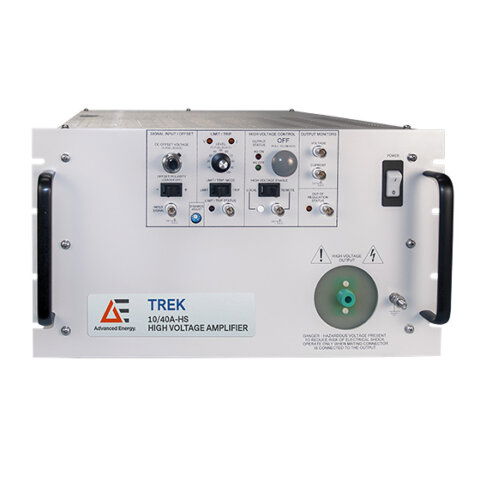
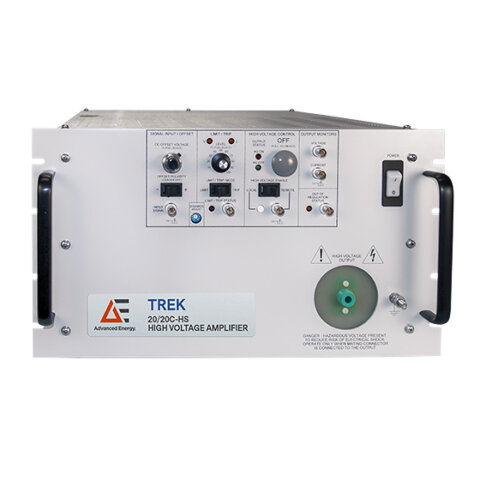
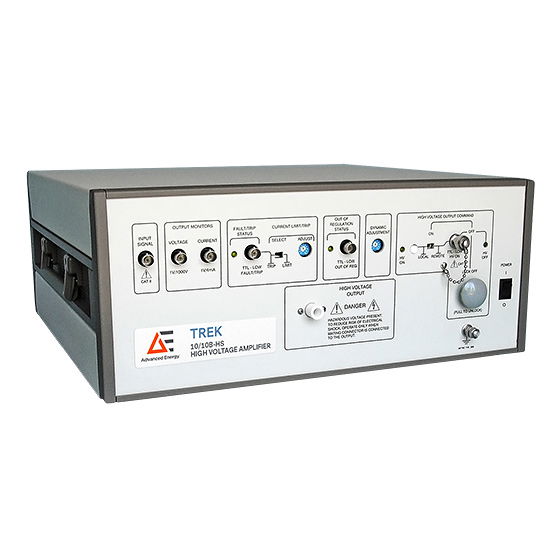
The TREK 10/10B-HS-H-CE is a high-speed, high-voltage amplifier designed for precision control of up to 10 kV outputs. It features a four-quadrant active output stage, allowing it to source or sink current into both resistive and capacitive loads across the full voltage range. This capability makes it ideal for tasks such as material poling, electrostatic deflection, and AC or DC biasing in laboratory or industrial settings. The amplifier’s closed-loop, solid-state design ensures excellent stability and accuracy, with minimal output noise even at high voltages. Engineers and researchers benefit from its DC stability and fast slew rate, enabling responsive and reliable high-voltage drive in applications ranging from advanced material testing to precision electro-optic modulation.
Range features
A high level overview of what this range offers
- Four-quadrant output design – Allows the amplifier to both source and sink current, ensuring precise control of capacitive or resistive loads without performance loss
- High slew rate > 700 V/µs – Achieves rapid voltage transitions, enabling fast tracking of dynamic signals and improved response in high-frequency applications
- Wide bandwidth (DC to 60 kHz small-signal) – Covers DC up to tens of kilohertz with small signals, supporting a broad range of AC and transient test scenarios
- Large-signal bandwidth to ~20 kHz – Handles high-amplitude signals up to about 19.5 kHz (-3 dB point), suitable for driving larger reactive loads at significant voltage swing
- Low output noise, closed-loop operation – Delivers ultra-stable output with noise under 0.5 V RMS, preserving signal fidelity for sensitive experiments and measurements
- DC-stable and programmable – Maintains a stable DC output with high accuracy; can be driven by an analog input (±10 V) for easy integration into programmable test setups
- Local and remote HV on/off control – Offers both front-panel and remote interlock controls to safely enable or disable the high-voltage output as needed
- Built-in protection features – Includes short-circuit protection and fault status indicators to safeguard the amplifier and connected devices from overload or misuse
- Maintenance-free solid-state design – Uses an all solid-state architecture for high reliability and zero routine maintenance, maximising uptime in continuous operation
- CE compliant with calibrated output – Meets international safety standards (CE) and comes with a NIST-traceable calibration certificate, ensuring confidence in performance and accuracy out of the box
Downloads
for 10/10B-HS-H-CE High Voltage Amplifier 10 kV, 40 mA
Datasheet: 10/10B-HS-H-CE High-Voltage Amplifier (PDF) – Detailed specifications and performance data.
DownloadWhat’s in this range?
All the variants in the range and a comparison of what they offer
| Specification | 10/10B-HS-H-CE |
|---|---|
Output Voltage Range | 0 to ±10 kV DC or peak AC |
Output Current Range | 0 to ±10 mA DC, ±40 mA peak (for 1 ms) |
Slew Rate (10%–90% rise) |
|
Small-Signal Bandwidth (-3 dB) | DC to > 60 kHz |
Large-Signal Bandwidth (-3 dB) | DC to > 19.5 kHz |
Large-Signal Bandwidth (1% THD) | DC to > 9.5 kHz |
Voltage Gain | 1000 V/V (fixed) |
Input Voltage Range | 0 to ±10 V (for full output) |
Input Impedance | 20 kΩ (nominal) |
Output Impedance | 47 Ω |
DC Gain Accuracy | ≤ 0.1% of full scale |
Offset Voltage (output) | < ±2 V |
Output Noise (output) | < 0.5 V RMS (typical) |
Stability – Drift (Time) | < 100 ppm/hour (non-cumulative) |
Stability – Drift (Temp) | < 100 ppm/°C |
Voltage Monitor Ratio | 1 V per 1000 V of output |
Voltage Monitor Accuracy | ≤ 0.1% of full scale |
Voltage Monitor Offset | < ±3 mV |
Voltage Monitor Noise | < 20 mV RMS |
Current Monitor Ratio | 1 V per 4 mA of output |
Current Monitor Accuracy | Not stated (nominal monitoring for indication) |
Current Monitor Offset | Not stated |
Dimensions (H × W × D) | 190 mm × 432 mm × 417 mm (approx. 7.5″ × 17″ × 16.4″) |
Weight | ~14.9 kg |
Cooling | Forced air (built-in fan) |
HV Output Connector | Proprietary HV connector (shielded) |
Control Interface | BNC inputs (signal in, monitors, HV enable) |
Compliance/Certification | CE marked; NIST-traceable calibration included |
(Typical noise values measured over a specified bandwidth; details in datasheet)
FAQs
for 10/10B-HS-H-CE High Voltage Amplifier 10 kV, 40 mA
This amplifier can drive both resistive and reactive loads (like capacitive or inductive loads) effectively. Its four-quadrant output design means it can source and sink current in both polarities. In practice, this allows the output to remain stable and accurate even when driving highly capacitive loads or when the load current reverses direction, which is crucial for applications like piezoelectric actuators or electrostatic devices.
The amplifier uses a fixed gain of 1000 V/V, so a ±10 V input signal is required to drive the output to ±10 kV. You can supply this control voltage from function generators or DACs. The unit provides analog monitor outputs for both voltage and current (scaled at 1 V per 1000 V output and 1 V per 4 mA output, respectively). These monitors allow you to observe the actual high-voltage output and load current on an oscilloscope or measurement system in real time, ensuring you have feedback on the amplifier’s output for precise control.
Small-signal bandwidth refers to the frequency range over which the amplifier can output a small amplitude voltage (typically a few percent of full scale) without significant attenuation, which for this model spans from DC up to about 60 kHz (-3 dB point). Large-signal bandwidth is the range for full-scale or high-amplitude signals (close to the maximum voltage) and is lower – roughly up to 19.5 kHz (-3 dB). In short, the amplifier can reproduce higher frequency content when the output voltage swing is small, but for very large voltage swings, the maximum frequency is limited to around tens of kilohertz to maintain fidelity.
The 10/10B-HS-H-CE has a very high slew rate of over 700 V/µs. This spec indicates how quickly the output can change by 700 volts in one microsecond. In practical terms, such a high slew rate means the amplifier can reach the commanded voltage extremely quickly. For example, a 1 kV step change would settle in just a few microseconds. This is beneficial for driving fast-changing waveforms or transient events, ensuring the high-voltage output accurately follows rapid input signal changes without undue delay.
Safety is a key consideration at such high voltages. The amplifier includes an interlock-enabled HV On/Off control that can be operated locally (via a front-panel switch) or remotely (via a connector), so you can quickly disable the high-voltage output if needed. It has an inherent short-circuit protection, meaning if the output is accidentally shorted or overloaded, the amplifier will limit the current and go into a protected state to prevent damage. Status indicators are provided to show if the unit is in a fault or out-of-regulation condition. Additionally, the unit is CE compliant, which means it meets rigorous safety and EMC standards. Always following the user manual guidelines (such as proper grounding and using the safety interlock) further ensures safe operation in high-voltage environments.
Yes, the amplifier is designed for precision and stability. It features a DC offset voltage of less than ±2 V, which is very small relative to the 10 kV range, ensuring you can accurately set zero output when needed. The drift over time is specified to be under 100 ppm per hour (non-cumulative), and drift with temperature is under 100 ppm/°C, meaning the output will remain stable over long experiments or as ambient conditions change. The low noise output (on the order of microamps of current noise and a fraction of a volt voltage noise) means it can drive sensitive devices like electro-optic modulators or high-voltage reference tests without introducing significant measurement error. Each unit is provided with a calibration certificate traceable to national standards (NIST), giving confidence in its accuracy for precision applications.
This high-voltage amplifier finds use in both R&D and industrial contexts wherever precise high-voltage control is required. Typical applications include polarising ferroelectric or piezoelectric materials (material poling), where a controlled high DC voltage is needed; electrostatic deflection or beam steering systems in scientific instruments; high-voltage component testing and insulation breakdown studies; as well as AC biasing of devices in semiconductor or materials research. Because of its fast response, it’s also used in driving piezo actuators or MEMS devices that require high voltage and high speed. In industrial settings, it can support processes like electrospinning, dielectric film testing, or precision high-voltage piezo control in manufacturing equipment. The unit’s versatility and control precision make it suitable for universities, national labs, and advanced manufacturing companies that deal with high-voltage technologies.