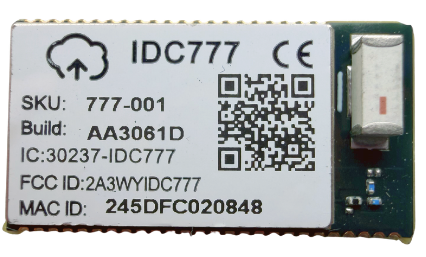
IDC777 Bluetooth 5.3 LE Audio LGA module (with antenna)
- Technology
- Bluetooth modules
- Partner
- IOT747
The IDC777 Bluetooth 5.3 Audio module is a compact wireless solution designed for high-quality audio applications in both Bluetooth Low Energy Audio (LE Audio) and classic Bluetooth domains. It combines support for the new low-power LC3 codec and Auracast broadcast audio with traditional Bluetooth audio profiles like A2DP and HFP, enabling versatile use cases from music streaming to two-way voice communication. Measuring only 11.8 × 22.2 mm, this module comes with a built-in chip antenna (with an IDC767 variant available for external antenna setups), making it easy to integrate into space-constrained designs.
Built on a latest-generation Qualcomm Bluetooth 5.3 chipset, it supports advanced features such as aptX HD/Lossless and Snapdragon Sound for high-fidelity audio, while maintaining ultra-low power consumption suitable for battery-powered devices. Integration is simplified through a high-level UART command interface (the AudioAgent firmware), which lets developers control audio profiles, pairing, and streams without deep Bluetooth protocol expertise. With comprehensive pre-certifications (Bluetooth SIG, FCC, CE/RED, etc.), the IDC777 series helps reduce development time and regulatory hurdles for bringing next-generation wireless audio products to market.
Range features
A high level overview of what this range offers
- Dual-mode Bluetooth 5.3 (LE Audio + Classic) – Ensures compatibility with next-gen LE Audio devices and legacy Bluetooth audio products, including support for Auracast broadcast and standard profiles.
- Snapdragon Sound with aptX HD/Lossless support – Enables high-bitrate, low-latency audio streaming, delivering audiophile-grade wireless sound quality on supporting devices.
- Integrated analog codec (100 dB SNR) & I2S digital output – Provides flexible audio output options (direct stereo line-out or digital PCM) with excellent sound clarity for both music and voice.
- Ultra-low power consumption (< 4 mA streaming) – Optimised for battery-powered operation, allowing extended runtime and direct supply from a Li-ion battery (3.3 V–4.7 V) without excessive drain.
- High-level UART command interface (AudioAgent) – Simplifies control of audio functions (pairing, profile selection, etc.) via AT-style commands, so you can integrate the module without writing low-level Bluetooth code.
- Comprehensive audio profile support – Supports music streaming (A2DP source & sink, AVRCP control) and wideband voice calls (HFP/HSP, including super wideband speech), plus BLE data profiles (GATT, SPP, HID) for versatile wireless connectivity.
- Tiny 11.8 × 22.2 mm form factor – Saves PCB space, ideal for compact devices like hearables, portable audio gear, or sensors, while still running the full Bluetooth audio stack and codecs on-module.
- Integrated chip antenna (IDC777) – On-board antenna design simplifies RF integration and assembly, providing up to ~25 m wireless range (line-of-sight to a smartphone) with no external antenna required.
- External antenna option (IDC767) – U.FL/antenna pad available on the IDC767 variant allows the use of external antennas for maximised range (potentially 100 m+ line-of-sight) and optimal antenna placement in challenging environments.
- Pre-certified (Bluetooth, FCC, CE, etc.) – Delivered with full module certifications (Bluetooth SIG, FCC US, CE RED EU, MIC JP, KCC KR, SRRC CN), greatly reducing the time and cost needed for regulatory approval of your end product.
Downloads
for IDC777 Bluetooth 5.3 LE Audio LGA module (with antenna)
IDC777 Brochure
DownloadIDC777 Command Manual (latest)
DownloadIDC777 Command Manual (AA3170)
DownloadIDC777 Datasheet
DownloadIDC777 Certification Compliance
DownloadIDC777-DISKIT (Dev Kit) Schematics
DownloadIDC767 Datasheet
DownloadMikroe IDC777 Add-on Board Guide
DownloadIDC777 Headset Use Cases (Application Note)
DownloadIDC777 Intercom Use Cases (Application Note)
DownloadIDC777 Audio Use Cases (Application Note)
DownloadIDC777 Infrastructure Use Cases (Application Note)
DownloadIDC767 Long Range Application Note
DownloadIDC777 & IDC767 Product Brief
DownloadIDC777 3D Step Files (CAD models)
DownloadIDC767 3D Step Files (CAD models)
DownloadIDC777 ATEX Component Info
DownloadWhat’s in this range?
All the variants in the range and a comparison of what they offer
| Specification | IDC767 (External Antenna) | IDC777 (Integrated Antenna) |
|---|---|---|
Bluetooth Standard | 5.3 (Dual Mode: Low Energy + Classic) | 5.3 (Dual Mode: Low Energy + Classic) |
LE Audio Support | Yes – LC3 codec, Auracast broadcast & unicast | Yes – LC3 codec, Auracast broadcast & unicast |
Classic Audio Codecs | SBC, AAC, aptX, aptX-HD, aptX-Lossless (Snapdragon Sound) | SBC, AAC, aptX, aptX-HD, aptX-Lossless (Snapdragon Sound) |
Audio Profiles | LE Audio broadcast; Classic A2DP (Source/Sink), AVRCP, HFP/HSP, SPP, HID | LE Audio broadcast; Classic A2DP (Source/Sink), AVRCP, HFP/HSP, SPP, HID |
Audio Outputs | Analog stereo line-out (100 dB SNR); I2S / PCM digital audio | Analog stereo line-out (100 dB SNR); I2S / PCM digital audio |
Host Interfaces | UART (AudioAgent AT commands), I²C, USB, GPIO (LED indicators) | UART (AudioAgent AT commands), I²C, USB, GPIO (LED indicators) |
Power Supply | 3.3 V – 4.7 V DC (direct battery supported) | 3.3 V – 4.7 V DC (direct battery supported) |
Power Consumption* | ~4 mA (active music streaming); < 0.1 mA (idle connected) | ~4 mA (active music streaming); < 0.1 mA (idle connected) |
Dimensions | 11.8 mm × 22.2 mm × ~3 mm height | 11.8 mm × 22.2 mm × ~3 mm height |
Antenna | External antenna connector (50 Ω) | Integrated PCB chip antenna |
Typical Range | Antenna-dependent (extended range, e.g. 80–100 m line-of-sight with suitable antenna) | ~25 m line-of-sight with on-board antenna (to standard smartphone) |
Certifications | Bluetooth SIG, FCC (USA), CE RED (EU), MIC (Japan), KCC (Korea), SRRC (China) | Bluetooth SIG, FCC (USA), CE RED (EU), MIC (Japan), KCC (Korea), SRRC (China) |
Power consumption values are approximate and depend on usage profile (streaming audio vs idle scenarios).
FAQs
for IDC777 Bluetooth 5.3 LE Audio LGA module (with antenna)
IDC777 and IDC767 are functionally identical Bluetooth 5.3 audio modules, but they differ in antenna configuration. The IDC777 comes with an integrated chip antenna on the module, making it a self-contained solution. In contrast, the IDC767 is designed without an onboard antenna and instead provides a connector/pad for an external antenna. This means if you need to maximise wireless range or position the antenna elsewhere in your device for optimal performance, the IDC767 offers that flexibility. The trade-off is simply the external antenna requirement – otherwise, all audio features, profiles, and interfaces are the same on both versions.
Yes, the IDC777 fully supports Bluetooth LE Audio, including the new Auracast feature. LE Audio is the latest Bluetooth standard for audio, using the LC3 codec which offers high-quality sound at lower power consumption than classic Bluetooth audio. Auracast is a broadcast audio capability in LE Audio that allows one audio source to stream to many receivers simultaneously (for example, one IDC777 transmitter broadcasting music to multiple earbuds or speakers). With IDC777, you can implement these advanced features – for instance, creating assistive listening systems, public audio broadcasts, or sharing music with multiple people – all while benefiting from the power efficiency and improved audio quality of LE Audio.
The IDC777/767 supports a wide range of audio codecs and profiles to ensure compatibility and high fidelity. On the classic Bluetooth side, it handles standard SBC and AAC codecs as well as advanced Qualcomm codecs like aptX, aptX-HD, and aptX-Lossless (part of the Snapdragon Sound suite) for superior audio quality and low latency. On the Bluetooth LE side, it uses the LC3 codec for LE Audio. In terms of profiles, the module supports A2DP (Advanced Audio Distribution Profile) for stereo music streaming (as both source and sink), AVRCP for media remote control, HFP/HSP for hands-free voice calls (including wideband speech), and others like SPP (Serial Port Profile) and HID for data and peripheral connections. This means you can stream music in high quality, control playback, conduct voice calls, and even send data or keystrokes – all with one module.
Yes. The module is designed for bi-directional audio capability. It can operate as an audio source (transmitter) – for example, sending music from a portable device to headphones or speakers – and also as an audio sink (receiver), such as receiving audio from a phone to play through an amplifier or intercom. In Bluetooth Classic mode, it supports A2DP Source and Sink, so it can do both roles. It also supports broadcast and receive in LE Audio (Auracast), meaning one IDC777 can broadcast audio that multiple others receive, or it can receive someone else’s broadcast. Moreover, it has profiles for two-way voice: it can act as a headset or hands-free unit (HFP/HSP) so you could use it in a wireless microphone or a hands-free kit, and it can equally act as the audio gateway. In short, with appropriate configuration, one module can handle transmitting, receiving, or even doing both concurrently (for instance, receiving an audio stream and re-broadcasting it), giving you a lot of flexibility in audio system design.
The IDC777/767 modules are controlled via a UART interface using a high-level command set (referred to as AudioAgent commands). In practice, you integrate the module with your host microcontroller or processor over a UART serial line. Your host system sends simple ASCII commands (AT-like commands) to configure the Bluetooth module – for example, to manage pairing, select audio profiles, control playback, adjust volume, etc. The module’s firmware handles all the complex Bluetooth protocol tasks internally, so you do not need to write a Bluetooth stack from scratch. Additionally, the module offers other interfaces like I²C and USB which can be used for specific functionalities or firmware updates, but the primary control and configuration typically happen through UART. This approach makes it very straightforward for engineers to incorporate the IDC777: you send text commands and read status/responses, abstracting away the low-level details. The command manual provides the full list of commands and examples, so development and integration are quite developer-friendly.
Yes – one of the advantages of the IDC777/IDC767 modules is that they come pre-certified for major regulatory requirements. They have Bluetooth SIG certification, meaning you can list your product as Bluetooth-compliant without a separate qualification program (just a nominal listing process). They are also tested and certified for FCC (US), CE / RED (Europe), MIC (Japan), KCC (Korea), and SRRC (China). For device makers, this significantly reduces the cost and effort to get your end product approved since the wireless module already meets the essential radio and Bluetooth standards. In practical terms, as long as you integrate the module per the guidelines (e.g., proper antenna design for IDC767, no alterations to the RF components), you shouldn’t need to retest the radio characteristics of your product from scratch. This speeds up time-to-market and ensures you’re using a proven, compliant solution.
The IDC777 is designed to be power-efficient, making it suitable for battery-driven devices. It operates on a supply voltage between 3.3 V and 4.7 V DC, which conveniently covers the range of a typical single-cell Li-ion battery (approx. 3.7 V nominal). In terms of consumption, when actively streaming stereo audio (music playback), it typically draws around 3–4 mA, which is quite low for continuous audio and helps prolong battery life. When in an idle connected state (say, paired but not actively sending audio), the current drops to under 0.1 mA (under 100 µA in a deep sleep/standby mode while maintaining the connection). This means if your device spends a lot of time in standby or just occasionally transfers audio, the average power usage will be very low. There are also power-saving modes and the ability to disable certain features when not needed (for instance, turning off classic Bluetooth if only LE is used) to further optimise power draw. Overall, you can expect days to weeks of operation on a small battery (depending on usage patterns and battery capacity), which is ideal for wearables, portable speakers, or sensor nodes using these modules.
The IDC777 with its integrated antenna is optimised for typical portable device use – you can expect roughly 10 to 25 metres of reliable range indoors or line-of-sight (for example, streaming to a phone or headset in the same room). In open air without obstructions, 25 m is a practical guideline for maintaining a stable audio connection to a standard smartphone. The IDC767, on the other hand, allows you to attach a high-performance external antenna (for instance, a whip or dipole antenna or a PCB antenna mounted in a better location). With a suitable external antenna and clear line-of-sight, the range can significantly exceed 25 m – often reaching on the order of 50 to 100 m, or even more in ideal conditions. In fact, in some long-range test scenarios (module-to-module with optimal antennas), distances around 100–150 m have been demonstrated for audio streaming. The external antenna option is especially beneficial in RF-challenging environments (like inside metal enclosures or across multiple rooms), or when you need coverage over a larger area (e.g., outdoor event broadcasting). Keep in mind that obstacles, radio interference, and the antenna gain all affect range – but generally, IDC767 + a good external antenna will outperform IDC777’s built-in antenna in range.