EM9291 5G Sub6 GHz M.2 module
- Technology
- 5G modules
- Partner
- Semtech (formerly Sierra Wireless)
The EM9291 5G module is a 5G NR Sub-6 GHz cellular module in a standard M.2 form factor, providing high-speed wireless connectivity for a broad range of IoT and industrial applications. It delivers gigabit-class data rates – with peak downloads up to 4.9 Gbps and uploads up to 660 Mbps – enabling bandwidth-intensive tasks and real-time data streaming. The module automatically falls back to 4G LTE Cat-20 and 3G networks if 5G coverage is unavailable, ensuring continuous connectivity across evolving network environments. An integrated multi-constellation GNSS receiver (GPS, GLONASS, BeiDou, and Galileo) with dual L1/L5 band support provides precise positioning and tracking for location-based services. With extensive global band support and carrier certifications, the EM9291 can be deployed worldwide, accelerating time-to-market for devices that require cellular connectivity.
Its M.2 interface and compatibility with earlier EM Series modules (such as the 4G EM7690 and 5G EM9191) make integration and upgrades straightforward for developers moving from LTE to 5G. An optional embedded eSIM (eUICC) adds flexibility by allowing remote provisioning and multiple operator profiles, complementing the dual SIM support for network redundancy. Built for reliability, the EM9291 features secure boot for firmware integrity and is tested to operate in harsh environments (with an extended temperature range from -40 °C to +85 °C), making it suitable for both indoor and rugged outdoor deployments.
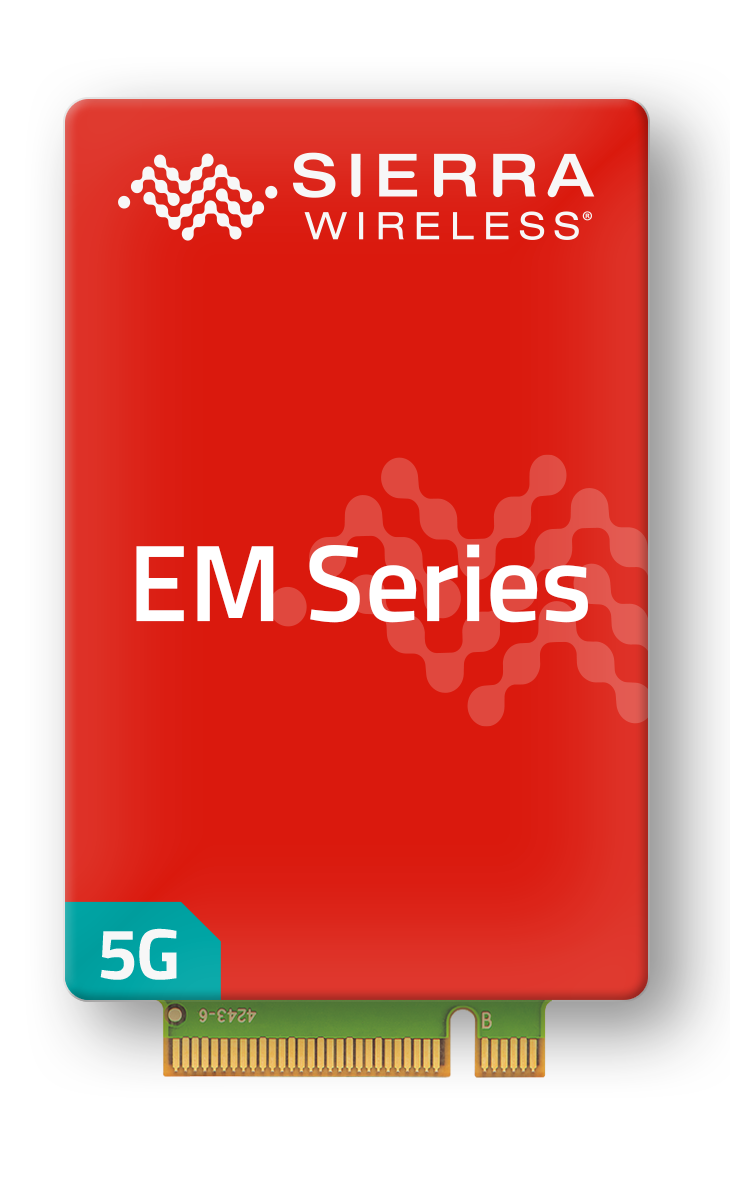
Range features
A high level overview of what this range offers
Embedded 5G NR Sub-6 module delivering up to 4.9 Gbps downlink (and 660 Mbps uplink) in a compact M.2 form factor. Provides global coverage with 4G LTE/3G fallback and supports integrated GNSS for precise positioning, ideal for high-performance IoT and industrial applications.
- 5G NR Sub-6 connectivity – Offers up to 4.9 Gbps downlink and 660 Mbps uplink for ultra-fast wireless data throughput in demanding applications.
- 4G/3G network fallback – Automatically switches to LTE Cat-20 or 3G networks if 5G is unavailable, ensuring uninterrupted connectivity and wide-area coverage.
- Global band support – Covers extensive 5G and 4G frequency bands in one module, along with multi-region certifications, simplifying worldwide deployment and logistics.
- CBRS private network support – FCC certified for CBRS Band 48, enabling reliable and secure private LTE/5G networks for enterprises and industrial sites.
- Integrated GNSS receiver – Built-in multi-constellation GNSS (GPS, Galileo, GLONASS, BeiDou) with dual L1/L5 bands provides high-accuracy positioning for navigation and asset tracking.
- Dual SIM & eSIM flexibility – Supports dual SIM (single standby) operation and offers an optional onboard eUICC (embedded SIM), giving flexible carrier selection and network redundancy for IoT deployments.
- Secure boot firmware – Ensures only authorized firmware runs on the module, protecting device integrity and network security by preventing unverified code execution.
- Industrial-grade design – Rugged module tested for harsh conditions and extended temperatures (-40 °C to +85 °C), suitable for industrial routers, outdoor systems, and other demanding environments.
Downloads
for EM9291 5G Sub6 GHz M.2 module
What’s in this range?
All the variants in the range and a comparison of what they offer
| Specification | EM9291 5G Sub-6 GHz M.2 Module |
|---|---|
Air Interface | 5G NR (Sub-6 GHz) – fallback to 4G LTE and 3G |
5G NR Category | Sub-6 only (dual-mode 5G SA/NSA) |
5G NR Bands | n1, n2, n3, n5, n7, n8, n12, n13, n14, n18, n20, n25, n26, n28, n29, n30, n38, n39, n40, n41, n46, n48, n66, n70, n71, n75, n76, n77, n78, n79 |
4G LTE Category | Cat-20 (LTE-Advanced Pro) |
4G LTE Bands | B1, B2, B3, B4, B5, B7, B8, B12, B13, B14, B18, B19, B20, B21, B25, B26, B28, B29, B30, B32, B34, B38, B39, B40, B41, B42, B43, B46, B48, B66, B71 |
Peak Download Rate | 4.9 Gbps |
Peak Upload Rate | 660 Mbps |
GNSS (Satellite Systems) | GPS, GLONASS, Galileo, BeiDou (dual-band L1/L5 support) |
Embedded SIM (eUICC) | Onboard embedded SIM support (optional, user-programmable profiles) |
External SIM Interfaces | Dual SIM support (2× external SIM slots, single standby) |
Host Interface | M.2 (NGFF) connector, USB 3.1 and PCIe Gen3 (1 lane) |
Software Drivers | Windows 10, Linux, Android (RIL) |
Firmware Features | Secure Boot; pre-certified firmware variants onboard |
Dimensions (W×D×H) | 30 mm × 52 mm × 2.38 mm |
Operating Temperature | -30 °C to +70 °C (Extended range: -40 °C to +85 °C) |
Carrier Approvals | AT&T (FirstNet), Verizon, NTT Docomo, T-Mobile, Telstra, SoftBank |
Regulatory Certifications | FCC, IC, GCF, KCC, PTCRB, EU RED, JATE/Telec |
FAQs
for EM9291 5G Sub6 GHz M.2 module
Yes. The EM9291 is a 5G NR Release 16 module that supports both standalone (SA) and non-standalone (NSA) network modes. This means it can connect to pure 5G networks as well as operate alongside LTE (in NSA mode), ensuring compatibility with current 5G deployments and future network upgrades.
The EM9291 provides automatic fallback to 4G LTE and 3G networks when a 5G signal is unavailable. It supports LTE-Advanced Pro (Cat-20) with extensive band coverage, and 3G UMTS, so devices stay connected virtually everywhere by dropping to the next available network technology without user intervention.
The module’s built-in GNSS receiver supports multiple satellite systems: GPS, GLONASS, Galileo, and BeiDou. It can receive signals on dual frequency bands (L1 and L5), which improves location accuracy and reliability. This multi-constellation support is useful for applications that require precise positioning or navigation capabilities.
Under ideal network conditions, the EM9291 can achieve download speeds of up to 4.9 Gbps and upload speeds up to 660 Mbps on 5G Sub-6 GHz networks. Actual data rates will depend on the mobile network capabilities (such as available bandwidth and carrier aggregation) and signal conditions. On 4G LTE networks (Cat-20 fallback), it can still deliver substantial throughput (up to hundreds of Mbps) to support high-data applications.
Yes. The EM9291 is an industrial-grade module designed to operate in harsh conditions. It has an extended operating temperature range from -40 °C to +85 °C, making it suitable for outdoor equipment and industrial use cases. The hardware has been tested against vibration, thermal stress, and other environmental factors to ensure reliable performance in rugged applications such as industrial routers, smart city devices, and remote monitoring systems.
The EM9291 comes in an M.2 form factor (Type 3042), which is a small mezzanine card commonly used in laptops, routers, and IoT gateways. It connects to the host board via a standard M.2 socket and communicates primarily over a USB 3.1 interface (for data, control, and firmware updates). Additionally, it provides a PCIe Gen3 interface (1 lane) that can be used for certain data paths or future use. This standardized form factor and interface make it straightforward to integrate into existing systems or carrier boards.
Yes. The EM9291 supports dual SIM functionality via two physical SIM interfaces, allowing one module to be provisioned with two different SIM cards (with single standby, meaning it can switch between two networks as needed for coverage or cost, but one SIM is active at a time). In addition, the module offers an optional embedded SIM (eSIM) capability through a built-in eUICC. This eSIM can be provisioned with operator profiles remotely, enabling devices to swap or add carrier subscriptions over-the-air without needing a physical SIM swap. These features give product developers flexibility in managing connectivity to different mobile network operators.
The EM9291 is pre-certified with many major network operators and regulatory bodies globally. For example, it has carrier approvals from AT&T (including FirstNet public safety network), Verizon, T-Mobile, Telstra, NTT Docomo, SoftBank, and others, depending on regional variants. On the regulatory side, it complies with standards and certifications such as FCC (USA), IC (Canada), GCF and PTCRB (global certification forums), KCC (Korea), JATE/Telec (Japan), and the EU Radio Equipment Directive (RED) for Europe. These approvals help speed up the device certification process, allowing integrators to deploy the module in end-products across multiple countries with fewer additional tests.
Yes. The EM9291 was designed with a similar M.2 interface and software architecture as earlier EM Series modules. It is pin-compatible with its 5G predecessor (EM9191) and provides a straightforward upgrade path from the 4G LTE EM7690 module. This means if you have hardware designed for EM9191 or EM7690, you can often replace or upgrade to EM9291 with minimal changes, immediately adding 5G capability. The continuity in form factor and interfaces simplifies migration from 4G to 5G in existing designs.