FB2M5KVR OptoLock POF Transceiver 10/100/250Mbps
- Technology
- Fibre optic transceivers
- Partner
- Firecomms
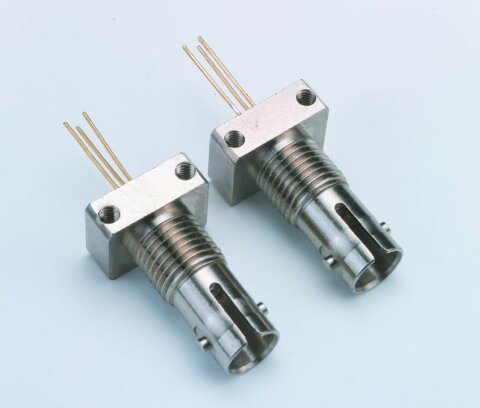
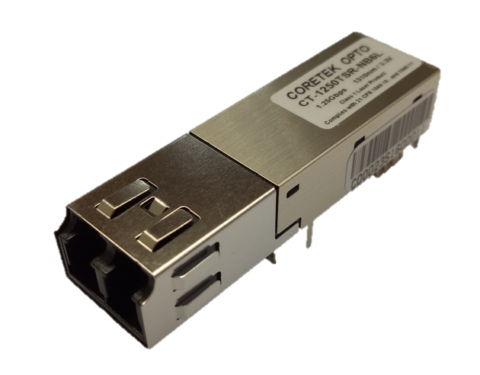
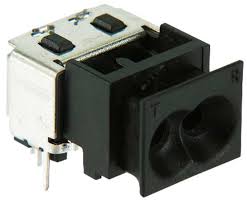
The FB2M5KVR OptoLock POF Transceiver is a duplex fibre-optic module designed to simplify and speed up industrial data communications. It features a patented OptoLock® interface that allows a standard 2.2 mm plastic optical fibre to be inserted directly into the transceiver without any connectors, making field installation and maintenance extremely quick and cost-effective. Supporting data rates from DC to 250 Mbps, this module easily handles fast Ethernet (100 BASE-FX) and other high-speed serial protocols commonly used in factory automation, robotics, and industrial control systems.
The transceiver integrates a 650 nm visible RCLED transmitter and a sensitive PIN diode receiver, along with built-in driver and receiver ICs that provide LVDS-compatible differential I/O. This means it can interface seamlessly with FPGAs, ASICs or communication controllers, offering noise-immune data links that are highly resistant to EMI/RFI interference. A visible red light emitted from the fibre helps technicians with setup and troubleshooting, yet remains eye-safe (Class 1). Engineered for reliability, the FB2M5KVR operates over an extended -40°C to +85°C range with a flame-retardant housing, ensuring dependable performance in harsh industrial environments.
Range features
A high level overview of what this range offers
- Direct OptoLock fibre termination – Allows bare 2.2 mm POF cable to be plugged straight in without connectors, simplifying installation and reducing costs.
- High data rate (up to 250 Mbps) – Supports 10 Mb, 100 Mb and higher-bandwidth protocols, making it suitable for Fast Ethernet and other real-time industrial communication needs.
- Visible 650 nm RCLED emitter – Provides a bright red light for easy alignment and fault-finding, while remaining Class 1 eye-safe for users.
- Integrated LVDS interface – Uses low-voltage differential signalling for noise-resistant data transmission; compatible with LVDS/LVPECL/CML logic for easy integration with standard PHYs and FPGAs.
- Signal detect output – Includes a built-in link status indicator pin that signals when the optical input is present, aiding in network diagnostics and system reliability.
- Low power consumption with sleep modes – Intelligent power-saving feature shuts off the transmitter LED and idles the receiver (drawing <25 µA) when no signal is present, minimising energy use in idle periods.
- Wide operating temperature (-40 °C to +85 °C) – Industrial-grade temperature range ensures reliable performance in harsh or outdoor environments.
- Rugged, flame-retardant housing – Durable connector housing (UL 94 V-0 rated) protects the optics and electronics, suitable for demanding industrial safety requirements.
- 50 m+ link distance over POF – Achieves typical distances of 50 metres at full 250 Mbps speed (up to ~100 m at lower speeds) using standard step-index POF, giving flexibility in network layout.
- Standards compliant – Fully RoHS compliant and adheres to IEC 60825-1 Class 1 eye safety, making it safe and environmentally compliant for global use.
Downloads
for FB2M5KVR OptoLock POF Transceiver 10/100/250Mbps
What’s in this range?
All the variants in the range and a comparison of what they offer
| Parameter | Value / Description |
|---|---|
Data rate | 10 Mbps to 250 Mbps (DC – 250 MBd) |
Optical interface | OptoLock® duplex POF port for 2.2 mm jacketed fibre |
Fibre type | 1 mm core plastic optical fibre (PMMA SI-POF) |
Wavelength | 650 nm (visible red RCLED emitter) |
Electrical interface | LVDS differential I/O (compatible with LVPECL/CML) |
Signal detect | Yes (digital output indicates optical link presence) |
Supply voltage | 3.0 V – 3.6 V DC (3.3 V nominal) |
Power consumption | Active: ~tens of mA (dependent on data rate); Idle: <25 µA (sleep mode) |
Operating temperature | -40 °C to +85 °C |
Link distance (typical) | 50 m at 250 Mbps over standard SI-POF (up to ~30 m in worst-case conditions) |
Housing | Through-hole module, UL 94 V-0 rated plastic housing |
Compliance | IEC 60825-1 Class 1 eye safety; RoHS compliant |
FAQs
for FB2M5KVR OptoLock POF Transceiver 10/100/250Mbps
The OptoLock interface uses a patented plugless design that lets you insert a bare plastic optical fibre directly into the transceiver’s port. There’s no need for a separate connector or special tooling – you simply cut the POF cable to length (even with a basic cutter) and push it into the OptoLock duplex receptacle. The internal locking mechanism secures the fibre in place instantly, greatly simplifying installation and enabling quick, on-site cable terminations.
This transceiver is designed for standard Plastic Optical Fibre (POF) with a 1 mm core and 2.2 mm outer jacket. No connectors are required at the fiber ends – the bare polished fibre is inserted directly into the OptoLock port. In practice, you can use any step-index POF cable suitable for 650 nm light; just cleanly trim the fibre end and push it in. The elimination of traditional fibre connectors not only saves cost but also makes field replacement or rerouting of cables extremely easy.
The FB2M5KVR supports data rates from DC (static signals) up to 250 Mbps (250 MBd line rate). This encompasses standard network speeds like 10 Mbps and 100 Mbps Fast Ethernet without any issues – in fact, it’s designed to handle the 125 MBd signalling of 100BASE-FX with plenty of headroom. The module is also suitable for other high-speed serial protocols up to 250 Mbps, including industrial fieldbus systems (for example, it can carry EtherCAT or Sercos III data, which use 100 Mbps physical layers). In short, any application within a quarter-gigabit range is within this transceiver’s capability.
In typical conditions, you can achieve around 50 metres of reliable communication at the full 250 Mbps data rate using standard step-index plastic optical fibre. Under worst-case conditions (for instance, very high temperatures, tight bends in the fibre, or ageing cable), the maximum distance at full speed is about 30 m. If you operate at lower data rates (e.g. 100 Mbps Fast Ethernet), the reach can extend further – distances up to approximately 80–100 m have been demonstrated with good quality POF at 100 Mb/s. Overall, the exact range depends on installation factors, but for most industrial setups the provided 50 m at maximum speed is more than sufficient.
The module uses differential LVDS signalling for both its transmitter input and receiver output. This means the data lines are low-voltage differential pairs, which are immune to noise and ideal for high-speed communication. To use the FB2M5KVR, your host device (e.g. an FPGA, microcontroller or Ethernet PHY chip) should have an LVDS-compatible interface for the TX and RX signals. If your system only provides single-ended (TTL/CMOS) signals, you would need driver/receiver chips to convert to LVDS. The OptoLock transceiver’s LVDS I/O is also broadly compatible (via AC-coupling) with other differential standards like LVPECL or CML, so it can be interfaced with a variety of communication controllers or SERDES transceivers as needed.
The Signal Detect (SD) pin is a status output that tells you whether a valid optical signal is being received. When the incoming light intensity is above the receiver’s threshold (i.e. there is an active link), the SD output will assert (typically a logic HIGH). If the optical signal is lost or too weak, the SD pin will drop (logic LOW), indicating no link. This is very useful for system diagnostics – it’s essentially a \"link status\" indicator, allowing your microcontroller or network equipment to detect if the fibre connection is up or if there has been a break or disconnect.
This OptoLock transceiver runs on a single 3.3 V DC supply (with a tolerance around 3.0 V to 3.6 V). When active and transmitting data at high speed, it typically draws on the order of tens of milliamps (the exact current depends on data patterns and usage). Importantly, the device includes power-saving modes to minimise energy consumption during idle periods. If there’s no data input, the transmitter’s driver IC enters a sleep state and the LED automatically turns off. Similarly, when no optical signal is present on the receiver side, the receiver IC goes into a low-power standby mode, drawing under 25 µA. These features mean the module conserves power when the link is inactive, which is beneficial for energy-sensitive applications.
Yes. The FB2M5KVR’s optical emitter is classified as Class 1 eye-safe under IEC 60825-1. The 650 nm red light it produces is visible, which helps you see that the link is active, but it is kept at a power level that is safe for the human eye under normal operation. Of course, as with any fibre optic or LED-based system, it’s good practice not to stare directly into the fibre or source from very close range. But in general use, the amount of light emitted is low enough that it won’t harm your eyes – it’s about the same class of safety as the light from a TV remote control (just visible). The visible red glow is an added safety feature, since you can immediately tell if a fibre is live during installation or troubleshooting.
The FB2M5KVR is a through-hole module intended to be mounted on a printed circuit board by its pins. It is not designed for standard SMT reflow soldering processes because of its plastic housing and internal optics – the high temperatures of reflow could damage it. Typically, you would solder this module using a wave solder process or by hand. It usually comes with a protective dust cap on the fibre port; you should keep that cap on during any soldering or PCB washing operations to prevent flux or debris from contaminating the optical interface. In summary, plan to insert it into the PCB and solder the leads conventionally (and observe handling guidelines, as the device has a moisture sensitivity level of 2a).
Both part numbers refer to 10/100/250 Mbps OptoLock transceivers with the same core performance, but they differ in their receiver diagnostics. The FB2M5KVR (the one discussed here) includes a digital Signal Detect output that simply indicates whether there is light or not. In contrast, the FB2M5KRR variant provides an RSSI output (Received Signal Strength Indicator). The RSSI pin on the KRR device gives a variable analog voltage proportional to the incoming optical power, allowing you to monitor the signal strength continuously. This can be useful if you need to gauge the link margin or detect gradual signal degradation. If you don’t require analog monitoring and just need a link/no-link indication, the FB2M5KVR is the straightforward choice; if you want to measure optical power levels, the FB2M5KRR would be the better option.