FB01GKAR 1Gbps POF OptoLock Plastic Optical Fibre Transceiver
- Technology
- Fibre optic transceivers
- Partner
- Firecomms
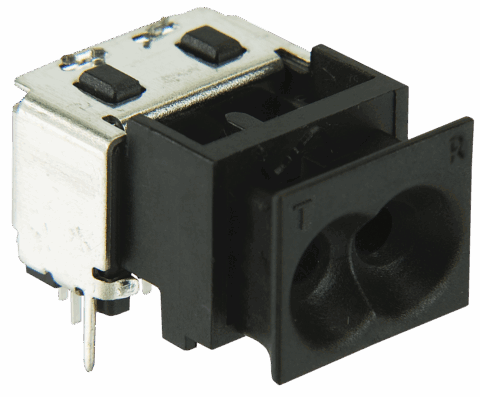
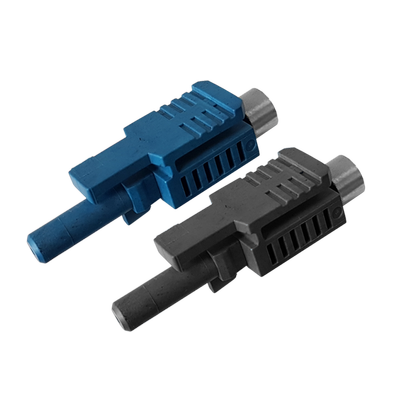
The FB01GKAR 1 Gbps OptoLock transceiver brings gigabit-speed optical connectivity to industrial and embedded systems in a convenient module. It combines a duplex optical transmitter and receiver in a compact housing that allows you to insert standard 1 mm POF cable directly, without any plugs or pre-terminated connectors. This design greatly simplifies installation – engineers can cut POF cabling to length on-site and simply push the bare fibre into the OptoLock port, saving time and cost.
The module’s visible 650 nm RCLED emitter provides an eye-safe red light output, making it easy to verify alignment and link status at a glance. With an LVDS differential interface and single 3.3 V supply, the FB01GKAR integrates seamlessly with Gigabit Ethernet PHY chips, FPGAs, or other high-speed logic. It’s built for harsh environments, operating reliably from -40 °C to +85 °C and housed in a flame-retardant UL 94 V-0 rated enclosure.
Typical applications include industrial Ethernet networks, high-speed motion control and vision systems, medical imaging equipment, and any scenario requiring EMI-immune data links or galvanic isolation at gigabit rates. By using this transceiver, designers can easily upgrade from copper to optical fibre links, gaining the benefits of noise immunity and safety isolation without complex integration.

Range features
A high level overview of what this range offers
-
OptoLock plugless fibre interface – Bare 1 mm POF cable inserts directly and locks in place, enabling quick termination and eliminating the need for costly fibre connectors.
-
Gigabit data rate over POF – Supports DC to 1.25 Gbps throughput, allowing for 1000Base-SX Gigabit Ethernet and other high-speed protocols over short optical runs.
-
Visible 650 nm LED source – Uses an eye-safe red RCLED emitter, which improves safety and lets users visually confirm link alignment and operation during installation and maintenance.
-
LVDS differential I/O – Low-voltage differential signaling interface ensures easy integration with standard gigabit SERDES/PHYs or FPGA I/O, providing high noise immunity and minimal signal conditioning.
-
Single 3.3 V supply, integrated driver – Operates from a single 3.3 V DC rail with built-in LED driver and receiver circuitry, simplifying power design. Typical power consumption is low (~0.46 W), making it efficient for embedded use.
-
Wide operating range – Designed for industrial temperatures (approximately -40 °C to +85 °C) and housed in a UL 94 V-0 flame-retardant casing, it delivers reliable performance in extreme or safety-critical environments.
-
Integrated RSSI output – Provides a Receiver Signal Strength Indicator pin for real-time monitoring of optical signal quality, aiding in system diagnostics and optimal fibre alignment.
-
Galvanic isolation & EMI immunity – The optical link inherently isolates transmitter and receiver electrically, eliminating ground loops and offering excellent immunity to electromagnetic interference for noise-prone applications.
Downloads
for FB01GKAR 1Gbps POF OptoLock Plastic Optical Fibre Transceiver
What’s in this range?
All the variants in the range and a comparison of what they offer
| Specification | Value |
|---|---|
Data rate | DC to 1.25 Gbps (supports Gigabit Ethernet) |
Optical wavelength | 650 nm (visible red RCLED emitter) |
Fibre interface | OptoLock® duplex port for 1 mm core POF (2.2 mm jacket) |
Link distance (max) | ~5 m with standard SI-POF; ~30 m with high-bandwidth GI-POF |
Electrical interface | LVDS differential I/O (compatible with 1000Base-SX SERDES) |
Supply voltage | 3.0 V – 3.6 V DC (3.3 V nominal) |
Power consumption | ~140 mA (@ 3.3 V) typical (~0.46 W) |
Operating temp. | -40 °C to +85 °C (industrial temperature range) |
Mounting type | PCB through-hole mounting (board-level module) |
Special features | RSSI analog output pin; RoHS compliant; UL 94 V-0 housing |
FAQs
for FB01GKAR 1Gbps POF OptoLock Plastic Optical Fibre Transceiver
The FB01GKAR supports data rates up to 1.25 Gbps, which covers the line rate needed for Gigabit Ethernet (1 Gbps) including the overhead of 8b/10b encoding. It is compatible with IEEE 802.3z Gigabit Ethernet standards – specifically, it can be used in place of a 1000Base-SX optical transceiver for short-distance links over POF. This means you can reliably run gigabit-speed networking or other high-speed serial protocols through this module, provided the link distances are kept within the supported range for POF.
One of the key advantages of the OptoLock transceiver is its plugless fibre termination. To connect a POF cable, you simply cut the 1 mm core fibre (with its 2.2 mm outer jacket) to the desired length, ensuring the cut is clean and perpendicular. Then insert the freshly cut end of the fibre into the OptoLock port on the transceiver. The OptoLock mechanism will grip and lock the bare fibre in place. There’s no need for a separate connector ferrule – the transceiver’s built-in latch holds the fibre securely. A small removable dust cap is usually provided; you take that out, insert the fibre until it clicks, and the link is ready. This makes field installation and replacement extremely quick.
The achievable distance depends on the type of POF and the data rate. At the full 1 Gbps speed, using standard step-index POF (1 mm core) you can typically reach about 5 metres reliably. If you use a graded-index POF (which has better bandwidth characteristics), the range extends – often around 20–30 metres is possible at gigabit rates under optimal conditions. These distances assume good fibre quality and alignment. In practice, 5–10 m covers most short interconnect needs in machines or racks with inexpensive step-index POF. For longer runs up to tens of metres, a graded-index polymer fibre would be recommended. Keep in mind that POF attenuation and dispersion increase with length, which is why the FB01GKAR is best suited for shorter distance high-speed links compared to glass fibre solutions used for 100+ metre networks.
The FB01GKAR employs LVDS (Low-Voltage Differential Signaling) for its electrical I/O on both transmitter and receiver sides. In practical terms, the module provides a differential TX input pair and a differential RX output pair that conform to standard LVDS levels. This makes it straightforward to interface with many common communication chips. For example, you can directly connect the TX± and RX± of the module to a Gigabit Ethernet PHY’s SERDES interface (1000Base-SX optical port) or to high-speed I/O pins of an FPGA/ASIC that speak LVDS. Termination resistors and coupling capacitors, if needed, should follow the recommendations of your PHY or the application circuit (the module itself is designed to have the appropriate impedance for LVDS). Thanks to the LVDS interface, you get a high-speed, noise-immune connection between the optical transceiver and your host device with minimal extra circuitry.
Yes. This transceiver includes an RSSI (Receive Signal Strength Indicator) output pin. The RSSI pin delivers an analog voltage proportional to the optical signal strength being received. By monitoring the RSSI level, your system’s microcontroller or logic can infer the link quality or detect if the incoming optical power is falling below a threshold. This is useful for diagnostics – for example, it can help with initial fibre alignment (you can wiggle the fibre and see the RSSI change) or for ongoing health monitoring (notifying if the link degrades due to fibre ageing or damage). In addition to RSSI, the internal design ensures a robust link: as long as the received optical power stays above the sensitivity limit, the data output will be a clean LVDS signal. Some designs also implement a signal detect function using the RSSI or a comparator, but the FB01GKAR itself primarily gives the analog RSSI output, leaving it to the designer to decide how to use that information.
Absolutely – it is specifically designed for industrial and demanding environments. The module operates across a broad industrial temperature range of -40 °C to +85 °C, so it can handle both freezing conditions and high heat often encountered in factory floors or outdoor equipment cabinets. The housing of the transceiver is made from a durable, flame-retardant thermoplastic (UL 94 V-0 rated) for safety and longevity. Moreover, using optical fibre instead of copper means the data link is inherently immune to electrical noise and surges – there’s no metal conductor, which provides excellent EMI/RFI immunity and galvanic isolation between the two ends. This makes the FB01GKAR very resilient in environments with lots of electrical interference (for instance, next to heavy machinery, motors, or radio sources). The transceiver’s through-hole mounting also gives it sturdy mechanical attachment to the PCB, which is beneficial under vibration or mechanical shock. Overall, it’s well-suited for industrial automation systems, automotive or transport electronics, and other applications where reliability under tough conditions is essential.
The FB01GKAR uses a Class 1 eye-safe LED source at 650 nm. The term “eye-safe” means that under normal operating conditions, the emitted light power is below the levels that could harm the human eye. In fact, one benefit of using a 650 nm visible red RCLED is that you can actually see a faint red glow when the transmitter is active – this is useful for troubleshooting and confirming the link is on, yet it’s not powerful enough to be dangerous. As with any bright light source, you wouldn’t want to stare directly into the fibre from close range; however, the output power of this transceiver is very low (on the order of a few hundred microwatts). It complies with the safety standards for LED-based fibre optic transmitters. In summary, there are no special safety precautions needed beyond common-sense handling of optical fibre (e.g. avoid looking into the fibre end with magnification). The device’s optical design prioritises user safety while providing sufficient optical power to maintain the data link over the specified distances.
Plastic optical fibre (POF) transceivers offer a unique combination of benefits. Firstly, POF is lightweight, flexible, and easy to handle – you can cut it with a simple tool and terminate it on-site (as the OptoLock system allows) without expensive connectors or skilled technicians, which isn’t the case for glass optical fibre. This makes installation and maintenance much simpler and more cost-effective. Compared to copper Ethernet cables, POF provides complete electrical isolation and immunity to electromagnetic interference, so you won’t have issues with ground loops, EMI noise, or lightning surges propagating along data lines. At the same time, because POF has a large core (1 mm), it’s very forgiving of alignment and vibration – the connection tends to be robust even if the fibre is jostled, which can be beneficial in industrial or automotive settings. In terms of performance, the FB01GKAR delivers Gigabit speeds over short distances which cover many applications like inside machinery, between PCBs, or across a room. While glass fibre can achieve longer distances, it’s also more fragile and requires precise connectors. Copper can do Gigabit over longer runs than POF, but it’s heavier, can radiate EMI, and is susceptible to noise. Thus, this POF transceiver hits a sweet spot for short-run high-speed links that need to be easy, safe, and reliable. It essentially combines the plug-and-play nature of copper with the signal quality of fibre – all in a form factor convenient for engineers.