POF Cable Assemblies LC / SMI / RedLink Versatile Link Connectors
- Technology
- Fibre optic cables, connectors and assemblies
- Partner
- Firecomms
Plastic Optical Fibre cable assemblies with LC, SMI, or RedLink connectors offer a plug-and-play solution for short-range optical links in demanding environments. Each assembly is a duplex POF patch cord pre-fitted with industry-standard connectors – LC duplex, SMI duplex, or RedLink® Versatile Link – to suit different system requirements. Using POF technology, these cables are immune to electromagnetic interference and provide electrical isolation, making them ideal for factory automation, high-voltage equipment, medical devices, and other EMI-sensitive applications. Installation is straightforward: no fibre splicing or special handling is required, as the connectors are already polished and attached.
The combination of flexible 1 mm polymer fibre and ruggedised connectors ensures reliable data transmission over distances of up to tens of metres (depending on transceivers), while supporting data rates for fieldbus, Ethernet, or serial links. Overall, these POF cable assemblies help engineers deploy high-reliability optical links quickly, whether retrofitting legacy Versatile Link systems or integrating POF into modern control networks.
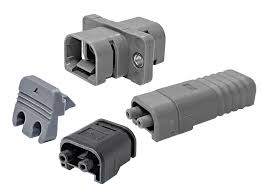
Range features
A high level overview of what this range offers
- Standard LC, SMI & Versatile Link interfaces – Choose from LC duplex, SMI duplex or RedLink (Versatile Link) connectors for compatibility with a wide range of optical transceivers and existing systems. This ensures easy integration without special adapters.
- Immune to EMI/RFI – Being optical, the POF cables are unaffected by electromagnetic noise. This results in more reliable data communication in environments with heavy electrical interference, high voltages, or radio emissions.
- Rugged connector design – All connector options are built for industrial use. LC and RedLink latching plugs feature positive locking mechanisms and high retention force (up to ~100 N for LC) to resist shock and vibration. Even the friction-fit SMI and RedLink connectors maintain a secure attachment, ensuring stable performance in motion-rich applications.
- Durable and long-lasting – The connectors support hundreds of mating cycles (500+ typical) without significant wear, allowing repeated disconnects for maintenance or reconfiguration. The POF cable’s polymer core is resistant to flexing and mechanical stress, and the assemblies use materials rated for longevity in harsh conditions.
- Wide operating temperature (-40 °C to +85 °C) – Designed to operate across industrial temperature ranges, these cable assemblies can handle outdoor climates, factory floors, or automotive environments. The connector materials and POF jacket remain stable in heat, cold, and thermal cycling, preserving link integrity.
- Flexible & easy to install – The duplex POF cables are lightweight and highly flexible, with a tight bend radius compared to glass fibre. This simplifies routing through machinery or tight spaces. Pre-polished connectors eliminate the need for on-site termination – simply plug in each end to establish a link.
- Fast, short-range data links – POF cable assemblies can support data rates suitable for protocols like Ethernet (10/100 Mbps) or industrial fieldbuses over typical distances (e.g. 30–50 m, depending on transceiver and link budget). This makes them effective for connecting sensors, controllers, and devices across factory cells or within medical equipment.
- Optional sealed connectors – RedLink friction plugs are available with an optional Light-Seal® feature (rubber sealing) to protect the optical link from dust, dirt, or moisture ingress. This can enhance reliability in dusty factories or outdoor installations.
- Custom lengths available – Standard cable lengths include 0.3 m jumpers, 5 m, 10 m, and 30 m, covering common use cases from bench testing to building-wide links. For unique requirements, custom lengths or special POF types (e.g. PCS fibre) can be provided on request, ensuring the solution fits your exact needs.
Downloads
for POF Cable Assemblies LC / SMI / RedLink Versatile Link Connectors
What’s in this range?
All the variants in the range and a comparison of what they offer
| LC Duplex POF Cable | SMI Duplex POF Cable | Versatile Link (RedLink) Latching | Versatile Link (RedLink) Friction | |
|---|---|---|---|---|
Connector type | LC duplex (latched) | SMI duplex (latched) | RedLink simplex (latching plug) ×2 | RedLink simplex (friction plug) ×2 |
Standard / Compatibility | IEC 61754-20 (LC) – common in telecom & industrial transceivers | IEC standard SMI – widely used for POF networking | Versatile Link compatible (Avago/Broadcom HFBR series) | Versatile Link compatible (same as latching, without latch mechanism) |
Fibre core | 1.0 mm Polymer Optical Fibre (SI-POF) – duplex zip-cord cable | 1.0 mm Polymer Optical Fibre (SI-POF) – duplex zip-cord cable | 1.0 mm Polymer Optical Fibre (SI-POF) – two-fibre duplex cable* | 1.0 mm Polymer Optical Fibre (SI-POF) – two-fibre duplex cable* |
Polarity / Colour coding | Both connectors identical (usually blue) | Both connectors identical (usually black or grey) | Connector pair with 1 grey + 1 blue (Tx/Rx identification) | Connector pair with 1 grey + 1 blue (Tx/Rx identification) |
Mating mechanism | Push-pull latch (snap-in LC) | Push-pull latch (snap-in SMI) | Push-button latch (secure locking) | Friction fit (retained by socket force) |
Durability (typical) | 500+ mating cycles | 500+ mating cycles | 500+ mating cycles | 500+ mating cycles |
Operating temp. | -40 °C to +85 °C | -40 °C to +85 °C | -40 °C to +85 °C | -40 °C to +85 °C |
Standard lengths | 0.3 m, 1 m, 5 m, 10 m, 30 m (custom on request) | 0.3 m, 1 m, 5 m, 10 m, 30 m (custom on request) | 0.3 m, 5 m, 10 m, 30 m (custom on request) | 0.3 m, 5 m, 10 m, 30 m (custom on request) |
Note: The RedLink Versatile Link assemblies use two simplex POF cables (joined as a duplex pair) with one connector on each fiber for a duplex link.
FAQs
for POF Cable Assemblies LC / SMI / RedLink Versatile Link Connectors
LC connectors are a standard small-form-factor duplex fibre optic interface commonly used in telecom and networking equipment. They have an integrated latch for secure mating. SMI connectors (Standardised Media Interface) are a duplex POF connector defined by IEC standards; they also latch into place and are popular for consumer and industrial POF applications (e.g. home networking, automation). RedLink connectors are Firecomms’ ruggedised versions of the Versatile Link simplex connector originally from Avago/Broadcom. A RedLink duplex link uses two simplex plugs (one Tx, one Rx, typically coloured grey and blue). RedLink plugs come in friction-fit or latching styles. In summary, LC and SMI offer a one-piece duplex connection, whereas RedLink/Versatile Link uses two single-fibre plugs and is chosen mainly for compatibility with legacy Versatile Link transceivers.
Yes. POF cable assemblies are immune to electromagnetic interference, so they deliver reliable data transmission in environments with high electrical noise where copper cables might suffer from signal degradation. For example, in a factory with large motors, welders, or radio equipment, a POF link will not pick up EMI/RFI. Additionally, POF provides inherent galvanic isolation (since it’s non-metallic), which is beneficial in high-voltage areas or between systems with different ground potentials. Many engineers use these POF assemblies to replace copper in cases where noise or ground loops have been problematic.
The practical range depends on the transceiver modules and link budget rather than the cable itself. Generally, with standard red-light (650 nm) POF transceivers, you can achieve about 50 metres of reach at data rates around 10–100 Mb/s. Some high-performance transceivers (e.g. using 660 nm LEDs or vertical-cavity lasers) can support up to 250 Mb/s or more over shorter lengths (10–20 m). For reference, a common limit is ~50 m for 100 Mb/s Ethernet over 1 mm SI-POF. These assemblies use high-quality polymer fibre with roughly 0.2 dB/m attenuation, and each connector introduces about 1 dB of loss. So for example, a 10 m cable with two connections might have ~12–14 dB total loss, which the transceivers must accommodate. Always check the transceiver’s datasheet – it will specify the maximum POF length at a given speed. If longer reach or higher bandwidth is needed, other fibre types (like HCS or glass fibre) might be considered, but for many short-distance (<50 m) needs, POF is a convenient and cost-effective choice.
Generally, yes, for many semi-harsh environments. The standard POF cable jacket is often PVC or PE, which can handle typical industrial indoor conditions and some outdoor exposure. The operating temperature range of –40 °C to +85 °C covers most outdoor temperature extremes. The connectors are made of durable engineering plastic (often UL V-2 rated for flame resistance) and can handle humidity and dust. However, prolonged UV exposure or direct water submersion is not recommended unless specified – standard POF can degrade in strong sunlight over time. For outdoor use, you might request cables with a protective outer sheath or UV-stabilised POF. Additionally, using the sealed RedLink connectors (with rubber dust seals) can help keep moisture and dirt out of the connection in harsh conditions. In summary, these assemblies are robust for industrial use and occasional outdoor duty, but for continuous outdoor installation it’s wise to take protective measures or consult for a specialised version.
Yes, one advantage of polymer optical fibre is its ease of field termination. If you purchase the connectors separately, you can assemble your own cables or repair a broken cable on site. For example, the LC and SMI connectors can be terminated with a simple polishing kit and crimp tool provided by the manufacturer. The RedLink Versatile Link connectors were designed for quick field termination: the friction style connectors require only stripping the fibre and crimping or latching the connector in place (and polishing the fibre end). In fact, Firecomms offers a crimpless RedLink connector variant that doesn’t even need a crimp tool – the fibre is held by an integral latch. Detailed instructions are provided (strip length, polishing method, etc.). For critical applications, a visual fault locator tool can help verify the termination quality. So while these pre-terminated assemblies save you time, you do have the flexibility to cut and re-terminate POF cables on your own if needed, without the complexity of glass fibre splicing.
Mechanically, yes, the LC POF duplex connector has the same dimensions as a standard LC connector defined by IEC 61754-20. This means it will plug into any LC duplex adapter or transceiver module. However, you must use it with transceivers that are designed for 1 mm POF or PCS fibre, not standard single-mode or multimode glass fibre. The POF core is much larger (1000 µm) and not made of glass, so a normal LC transceiver (designed for 9 µm or 50/125 µm glass fibre) will not couple light effectively into a POF cable. Firecomms and a few other manufacturers produce LC-format transceivers specifically for POF or large-core fibre – these have optics and electronics tuned for the POF’s characteristics (for example, red LED sources and larger photodiodes). In summary: the LC POF cable will physically fit an LC receptacle, but to function correctly it must be used with compatible POF optical devices or converters. Always ensure the optical transceiver and cable type are matched.
The grey and blue colouring on the RedLink (Versatile Link) connectors is a simple but useful feature for duplex links. It originates from the Versatile Link system convention: typically one colour (for example, grey) is used on the transmitter (Tx) end and the other colour (blue) on the receiver (Rx) end. This helps installers avoid cross-connecting channels – you can visually track which fibre is which. When connecting two devices, you would typically plug the grey connector at one end into the Tx port of Device A and the blue connector into the Rx port of Device A; then at the other end, do the corresponding grey-to-Tx and blue-to-Rx for Device B. This way, the colours guide a correct Tx-to-Rx pairing through the cable. In practice you can use them interchangeably (they are physically identical aside from colour), but following the colour convention makes maintenance easier. LC and SMI duplex connectors don’t have this issue because both fibres are in one duplex connector body, inherently keeping the pair together; with RedLink’s two separate plugs, the colours act as a keying aid to ensure proper connections.
Not typically with standard POF, as Gigabit (1000 Mb/s) is beyond the usual capability of step-index POF over useful distances. The standard 1 mm SI-POF with red LED transceivers is generally suitable up to around 125 Mb/s (Fast Ethernet) for tens of metres. That said, research and niche solutions exist for higher speeds: for example, graded-index POF or shorter lengths can push towards 1 Gb/s, and some POF transceivers use advanced modulation to achieve 1 Gb/s over 15–20 m. Also, plastic-clad silica (PCS) fibre (which has a glass core and plastic cladding) can be used with the same connectors and potentially carry Gigabit signals farther (since its glass core has lower attenuation). If your application requires Gigabit Ethernet or higher, you might consider using PCS fibre assemblies or traditional glass fibre cables with appropriate transceivers. However, those lose some of the easy-handling advantage of all-plastic fibre. The POF assemblies listed here excel in the sub-Gigabit regime (e.g. 10 Mb/s up to 100 Mb/s networks in cars, industrial sensor networks, etc.). For higher speeds, consult with the supplier – they may offer special solutions or can discuss if a short POF link might handle your required bandwidth.
Yes, one of the great benefits of optical fibre (including POF) is that it can co-exist with power cables and noise sources without issues. There’s no electromagnetic coupling between a fibre cable and electrical cables, so you won’t get crosstalk or induced noise. You can run a POF cable assembly in parallel with motor drive cables, AC mains, etc. without needing spacing or shielding that would be required for copper data cables. This simplifies retrofit installations – for instance, you might pull a POF cable through the same conduit as an old serial cable or near high-voltage lines and still maintain signal integrity. Do note that the plastic fibre isn’t rated for high temperatures that some power cables might reach, so ensure it’s not physically touching something extremely hot. Also, avoid crushing the fibre with tight cable ties, just as standard practice. But in terms of signal interference, you can treat these optical cables like they are “invisible” to electrical noise, which is a major advantage in industrial and medical scenarios.
Very little compared to electrical links. POF cable assemblies are quite maintenance-free. There are no copper conductors to corrode, and no RF connectors to loosen. However, you should keep the connector endfaces reasonably clean – dust or grease on the optical surface can attenuate the signal. The LC and SMI connectors often come with dust caps; it’s good practice to use them when a cable is unplugged. The RedLink connectors have an optional sealing cap for dust protection as mentioned. If you notice signal degradation over time, inspecting and cleaning the connectors can help (use a soft lint-free swab or canned air – avoid solvents that might attack plastic). Also, check that connectors are fully latched or inserted as vibration over years could rarely back a friction-fit connector out slightly (though they are designed to resist it). POF itself can darken a bit with very long-term use (years of exposure to high temperatures or UV light), but in most cases this is not significant. In summary, once installed, these POF cable assemblies require minimal upkeep – just occasional cleaning and ensuring the physical connections remain secure. This is one reason POF is popular in settings like vehicles and trains, where maintenance access is limited but high reliability is needed.