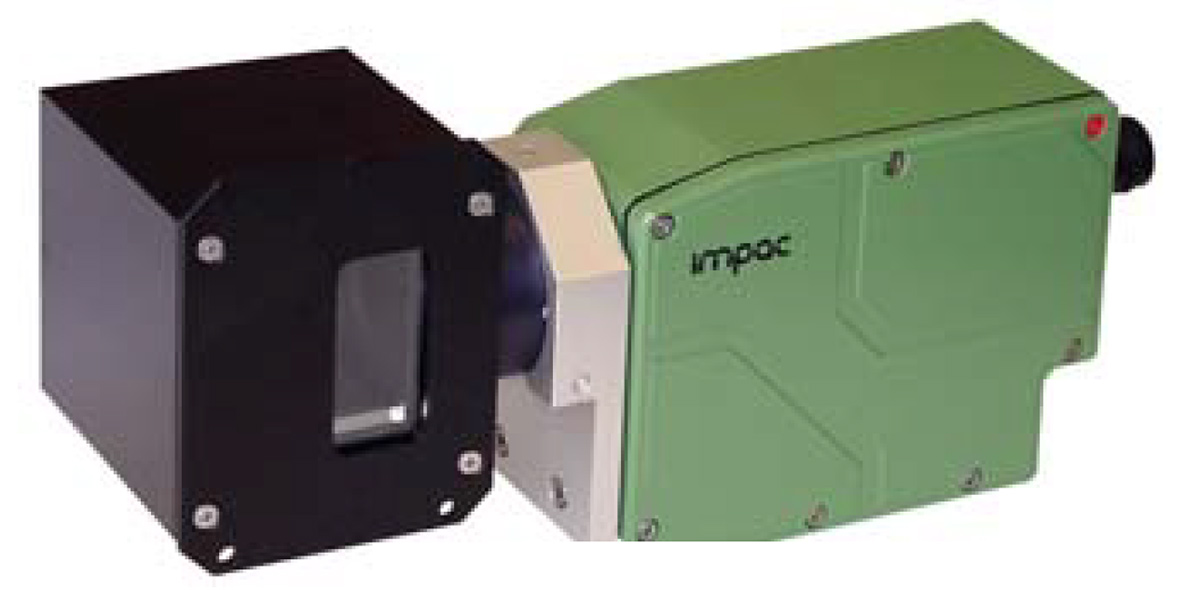
Pyrometer der Impac Serie für Metalloberflächen
- Technologie
- Pyrometer
- Partner
- Impac / Advanced Energy
Impac’s range of pyrometers provides a robust solution for measuring temperatures in demanding industrial environments without touching the target. These infrared devices are designed for applications such as steel production, metal forging, glassmaking, and ceramic kilns where traditional contact probes would fail or interfere with the process. By detecting thermal radiation, they deliver reliable readings from a safe distance, even on glowing metal surfaces and moving workpieces. This helps manufacturers improve process control, maintain consistent temperatures, and reduce overheating or product defects. The range includes single-colour models for general high-temperature measurement as well as two-colour ratio pyrometers for applications with fluctuating emissivity, dust, smoke, or partial obstruction. Measurement capabilities span from approximately -40 °C up to 3500 °C depending on series. Specialised optics, focusable lenses, and fibre-optic variants support small spot measurement, long-distance installation, and use in harsh environments. Modular platform options also allow scalable multi-sensor configurations for complex monitoring tasks.
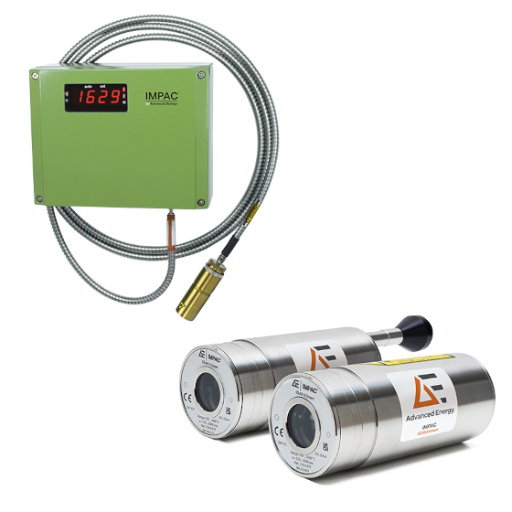
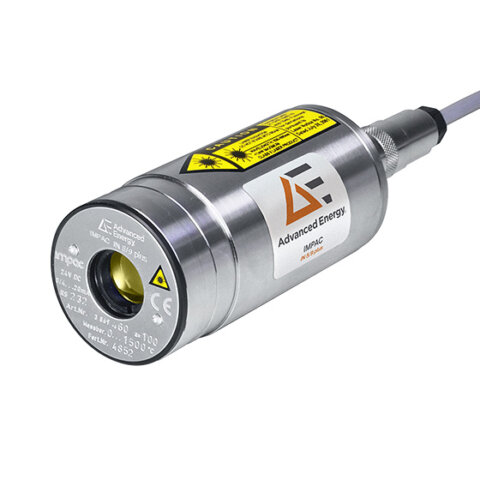
Impac pyrometers for metallic surfaces are built for reliable high-temperature measurement in industrial processes where contact sensors are impractical or would fail. These infrared pyrometers measure thermal radiation without touching the target, making them ideal for molten metal, forged parts, hot billets, ceramics, graphite, and other demanding applications.
The range includes compact fixed units, portable instruments, two-colour pyrometers, and fibre-optic pyrometers for installations exposed to heat, vibration, dust, smoke, or electromagnetic interference. With broad temperature coverage, flexible optics, and industrial output options, they provide dependable non-contact monitoring for process control, quality assurance, and equipment protection.
Eigenschaften
- Non-contact measurement: Measure extreme temperatures safely without sensor wear, contamination, or contact with molten or moving material.
- Wide temperature coverage: Available models cover approximately -40 °C to 3500 °C, supporting everything from low-start process zones to molten metal applications.
- High accuracy and repeatability: Advanced digital processing delivers stable, consistent readings for demanding industrial control tasks.
- Two-colour ratio technology: Selected models reduce errors caused by changing emissivity, smoke, dust, flames, or partially obstructed sight paths.
- Fast response times: Millisecond and sub-millisecond response options support dynamic thermal events and fast-moving production lines.
- Flexible optics: Fixed-focus and focusable optics enable precise measurement of very small targets or distant objects with defined spot sizes.
- Modular scalability: Platforms such as the Impac 600 Series support interchangeable heads and multi-sensor concepts for more complex installations.
- Rugged industrial design: Durable housings and fibre-optic variants support reliable operation in harsh environments with high ambient heat, vibration, or limited installation space.
Downloads
für Pyrometer der Impac Serie für Metalloberflächen
Verfügbare Modellvariationen
Alle verfügbaren Varianten und ein Vergleich ihrer Spezifikationen
Series | Description | Temp. Range (°C) | Spectral Range (µm) | Uncertainty | Interface / Output |
Impac 12 Series | High-end pyrometers for metals, ceramics, graphite | 250–3500 °C | Varies | — | Analogue + digital; various optics |
Impac 12-LO Series | Digital, fast two-colour with fibre optics (up to 30 m) | 250–3500 °C | 0.8 / 1.05 µm | 0.4–0.6% + 1 °C | 0–20 mA, RS232/RS485 |
Impac 12-TSP Series | Transfer standard pyrometers with thermostated detectors | 200–3000 °C | 0.65–1.57 µm | From 0.15% oR + 1 °C | 0/4–20 mA, digital |
Impac 218 Series | For metals, ceramics, graphite | 400–1500 °C | 0.85 & 1.8 µm | 0.75% oR | 0–30 mA |
Impac 50-LO plus Series | Fibre-optic pyrometers for metals, ceramics, graphite | 250–3500 °C | 0.55 & 1.8 µm | From 0.3% oR + 1 °C | 0/4–20 mA |
Impac 600 Series | Modular pyrometer platform with customisable sensor heads | -40 to 2500 °C | 0.7–14 µm | From 0.5% oR or 0.8 °C | 0/4–20 mA |
Impac 8 Series | Portable high-temperature pyrometers for metals and ceramics | 250–2500 °C | 0.55 & 1.8 µm | 0.4% oR + 1 °C | USB |
Impac Highspeed Series | Ultra-fast pyrometers for dynamic processes | 160–3500 °C | Varies | 0.75% oR | Analogue + digital; fibre options |
Impac IGA 140/23 Series | Low-temperature two-colour comfort class | 220–3000 °C | 1.45–1.8 µm | From 2 °C | Analogue + digital |
Impac IGA 320/23 Series | Mid-temperature version of IGA 140 | 250–2300 °C | 1.45–1.8 µm | From 0.3% oR + 1 °C | Analogue + digital |
Impac IGA 320/23-LO Series | Fibre-optic mid-temperature variant | 300–2500 °C | 1.45–1.8 µm | 0.5–0.7% + 1 °C | 0–20 mA, RS232/RS485 |
Impac IGA 6/23 Series | Compact low-temp pyrometers | 50–1800 °C | 2.0–2.6 µm | From 0.3% oR + 2 °C | USB, RS485 |
Impac IGAR 320 Series | Fibre-optic two-colour series | 300–1000 °C / 550–2500 °C | 1.52 / 1.64 µm | 0.5–0.7% + 1 °C | 0–20 mA, RS232/RS485 |
Impac IGAR 6 Series | Fast two-colour pyrometers with multiple modes | 100–2550 °C | 1.5 & 2.5 µm | From 0.4% oR + 2 °C | USB, RS485 |
Impac IPE 140 Series | High-accuracy digital pyrometers with focusable optics | 5–2000 °C | 3 & 5 µm | From 0.4% oR + 1 °C | 0/4–20 mA |
Impac IS 140 & IGA 140 Series | Comfort class short- and long-wavelength pyrometers | 550–3300 °C / 220–3000 °C | 0.7–1.1 µm / 1.45–1.8 µm | — | Analogue + digital |
Impac IS 320 & IGA 320 Series | Mid-temperature models | 300–2500 °C | 0.8–1.8 µm | From 0.3% oR + 1 °C | 0/4–20 mA |
Impac IS 6 & IGA 6 Series | Very fast, accurate pyrometers with focusable optics and LED display | 250–3000 °C | 0.9 / 1.05 µm | 0.3–0.6% + 1 °C | 0–20 mA, RS232/RS485, USB |
Impac ISR 320 Series | Stationary two-colour with optional line optics | 700–3000 °C | 0.9 / 1.05 µm | — | 0–20 mA, RS232/RS485 |
Impac ISR 6 Series | Stationary two-colour pyrometers | 600–3000 °C | 0.9 / 1.05 µm | < 1500 °C: 0.3% + 2 °C; > 1500 °C: 0.6% | 0–20 mA, RS232/RS485, analogue |
Impac ISR 6-TI Advanced | Two-colour pyrometer with integrated thermal imaging | 700–1800 °C | 0.9 / 1.05 µm | Same as ISR 6; 2 ms response | RS485, USB, analogue |
FAQs
für Pyrometer der Impac Serie für Metalloberflächen
A non-contact temperature sensor can measure extremely hot objects without physically touching them. In metallurgical and high-temperature processes, thermocouples may be damaged by molten metal, difficult to mount on moving material, or unsuitable because they risk contamination. An infrared pyrometer detects emitted radiation from the surface, allowing safe and continuous monitoring with low maintenance.
A two-colour pyrometer measures temperature at two nearby infrared wavelengths and compares the signal ratio. This helps reduce errors caused by changing emissivity, dust, smoke, flames, or partial obstruction. It is especially useful for shiny, oxidising, or moving metal targets where single-wavelength measurement may be less stable.
This depends on the optics and model selected. Many Impac units offer precision lenses and focusable optics for very small measurement spots, with some applications reaching around 0.5 mm at close range. High optical resolution also supports longer-distance measurement, while fibre-optic pyrometers allow the sensing head to be mounted close to the target and the electronics to remain further away.
Response times are typically in the millisecond range, making these sensors much faster than many contact probes. Certain models are designed for highly dynamic processes and can respond in sub-millisecond or even microsecond-level timeframes. This makes them suitable for moving products, short thermal events, and rapid process transitions.
Many models include built-in sighting aids such as a laser aiming point, optical sight, or LED spot indication. These help users align the sensor with the exact measurement area, even at a distance or through a viewing port. Focusable optics on selected models also allow the measurement spot to be adjusted for the target distance.
Most models are designed for industrial integration and provide analogue outputs such as 0–20 mA or 4–20 mA. Many also offer digital communication via RS232, RS485, or USB for configuration and data access. Depending on the series, this allows connection to PLCs, controllers, PCs, and broader process monitoring systems.
Yes. These pyrometers are built for harsh industrial settings and are available in rugged housings suited to high ambient temperatures, vibration, and difficult installation points. Fibre-optic pyrometers are especially useful where the optics must be placed near the heat source while the electronics remain protected. Optional accessories such as cooling, air purge, and protective mounting hardware further improve long-term reliability.
The sensors are factory calibrated and use stable detector designs to support long-term accuracy. Periodic recalibration using a suitable blackbody reference is recommended to verify performance over time. Many models also support emissivity adjustment, offsets, and self-diagnostic functions that help maintain reliable high-temperature measurement in daily operation.
Yes. Configuration and analysis software such as InfraWin can be used with compatible models via USB or serial connection. This software typically allows users to adjust parameters, view live readings, log temperature data, set alarms, and analyse trends. It is useful for both commissioning and ongoing process optimisation.
Selection depends on several factors: required temperature range, target material and emissivity behaviour, target size, installation distance, process speed, and environmental conditions. For example, a highly reflective or changing metal surface may benefit from a two-colour pyrometer, while a confined hot zone may require a fibre-optic pyrometer. Reviewing the series specifications and matching them to the application is the best way to identify the most suitable model.